
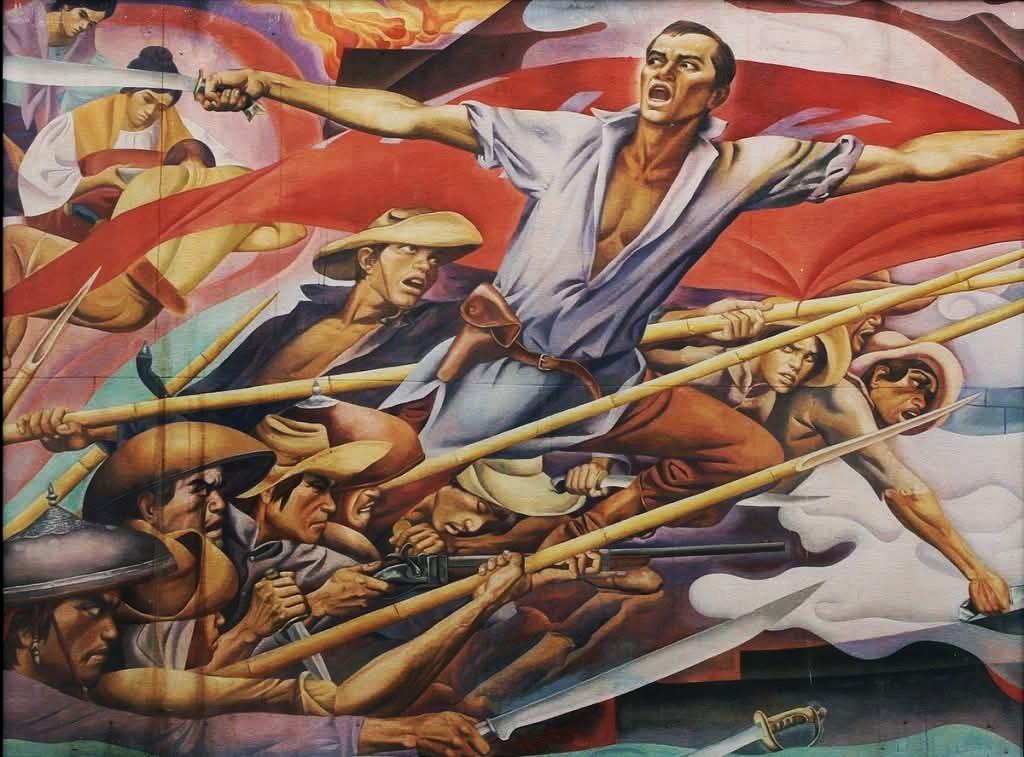
Reflections against heroic idolatry
“The social revolution […] cannot take its poetry from the past but only from the future. It cannot begin with itself before it has stripped away all superstition about the past. The former revolutions required recollections of past world history in order to smother their own content. The revolution […] must let the dead bury their dead in order to arrive at its own content.”
Karl Marx, The Eighteenth Brumaire of Louis Bonaparte (1852)
Every political tradition manufactures its saints. Busts of chiseled marble and bronze paraded every birth-and-death anniversary, memetic forces of supernatural consolidating passions. The bourgeois world, which claims, in the empirical body of the cold, secular rationality of science and market efficiency, to have abolished all mysticism, is paradoxically the most dependent on them. It is said that the limit of face-to-face human acquaintanceship is about 150 people; any more than that and the community starts to break down, then you’d need a certain bonding agent, a social structure, which transcends this limitation. Say, like a church. But it is not the church which glues people together, rather the marrow of the church itself, the singularity which summons the formal moment of the church in the first place: the myth. The doctrine; the liturgy; the breviary; the mass; God is the reification of humanity as a total subject, a self-causing, self-necessitating being fundamentally higher than and outside of nature. Myths, existing only in the minds of men, thus themselves social relations, are exceptional at mobilizing large swathes of human beings under a shared purpose and mission. Just about everything presently existing in bourgeois society is a myth, a reified form of social relationships between real sensuous human beings taking a life of their own. Laws, codes, corporations, the United Nations, school, money, these are all myths, generating none but greater and greater social bond. Perhaps among the biggest of these myths are the Nation and the State.
They conjure from thin air and bereft soil such powerful imaginaries and codes which constitute, supposedly, a shared political consciousness, a “general will”, from which the Law of the land and Popular Sovereignty of its State spring. A flag, clear-cut borders, a national language, a national cuisine, a national animal, and, most curious of all, be it a pantheon or a singular stand-out, a national hero. Nations, states, and the classes which animate them are draped in the vestments of historic great men, as if ensouled by myths of political consolidation. In the Philippines, no figure bears this weight more completely than Pater Patriae: Andres Bonifacio. More than a man, more than a revolutionary of a determinate moment, he has become a symbolic structure: father of the nation, patron of the oppressed, plebeian pope of revolt. Andres, whose earthly body is now chiseled in bronze and copper, floats above history, invoked by just about every faction of capital, self-conscious or otherwise, that seeks legitimacy in the register of the great endeavor of national emancipation.
Among all the rest, equally “patriotic” as they are, the National-Democratic movement has appropriated him most aggressively and completely. Where the CPP inaugurated itself at the helm as the inheritor and doctrinal continuation of the original PKP’s programmatic function as a “tribune of the people”, the National-Democratic movement found the sticks for its nest in the red dates of 1896’s revolutionaries. For decades, Bonifacio has served as the mythical foundation of its program, that emblem of the “unfinished revolution”, the unruly martyr whose dried blood, now still-spilling blood, sanctifies the National-Democratic cause, the perpetual witness whose memetic authority ratifies every call to unity, sacrifice, and national dignity. Andres Bonifacio is the first in the red flag of Filipino democratic revolutionism, ahead of the busts of Rizal (who inspired him, to begin with) and mid-late 20th-century nationalists Recto, Diokno, and Sison. The belief that revolution begins and ends with the liberation of the nation, that Filipino history must complete the work inaugurated by 1896 before the proletariat may claim its own, all emanate from the patriotic infrastructure of which the martyrs of Katipunan have, over the centuries, settled and become solid foundation.
To speak as a communist in a nationalist country is to speak as an apostate. And yet unlike most heresies worth formulating, which aims not destruction but clarification, we humbly seek both. Clarifying the proletariat’s historical horizon requires, ab initio, the ruthless destruction of patriotic superstitions. For the proletariat has no fatherland, and “how can we take from them what they have not got?”. And those who insist that it must inherit Bonifacio’s banner, and this is our persuasion, merely chain it once more to the political forms of the bourgeois epoch.
The cult of the individual
The worship of the Great Individual is the norm of bourgeois political life. It is the necessary counterpart to a society founded on the abstract humanist universalism of the sovereign individual, the contracting consenting citizen, the self-made man. The market is a venue of atomic individuals freely exchanging and voluntarily associating in production; the bourgeois state presents itself as the embodiment of the collective will of these individuals. When this abstraction must be rendered to taste for the so-called socialistic sophistication of the intellectual, given a face to feel and a story to tell, it condenses into the figure of the Hero. The Hero is the personification of the collective liberal-humanist aspirations of Liberty, Nation, Progress, and the adolescent passion of Revolution reminiscent of the bourgeoisie’s youth. He, and it is almost always a he, allows the impersonal and monstrous dynamics of capital and state power to be narrated as a human drama of will, sacrifice, genius, and all the rest.
Marxism, since its inception, was a scalpel for this idolatry:
“Men make their own history, but they do not make it as they please; they do not make it under self-selected circumstances, but under circumstances existing already, given and transmitted from the past.”
Marx’s famous dictum from The Eighteenth Brumaire is a direct assault on the history of great men. It insists on the primacy of social forces, class relations, and material conditions as constitutive of great historical epochs, of decades in weeks, so to say. The individual, even the extraordinary one, is a conduit for these forces, a nodal point where historical contradictions find expression and resolution. As such we speak of remarkable historic individuals as social phenomena specific to the times, as wholesale embodiments of their ages. Stalin as Stalinism, Lenin as Leninism, Mao as Maoism… ad infinitum. Yet this is not the same as positing of Great Men, since to focus on the individual as the prime mover is to fall into no less than the idealist mystification of the figurehead for the social current that lifts him to the sublime status of popular reverie.
The Communist Left, particularly the Italian tradition most aptly represented by the likes of Onorato Damen and Amadeo Bordiga, radicalized this critique into a principle of revolutionary organization and propaganda. It declared war on what it called personalism, the substitution of the party’s programmatic and class essence with the leadership, charisma, or lineage of specific individuals of note. For Bordiga, the class party was the “invariant program”, the historical consciousness of the proletariat incarnate. Its authority is derivative of its fidelity to the class’ organic doctrine and not from the qualities of its secretaries. The cult of Lenin, and later the monstrous deification of Stalin, were seen by the Left as profound regressions, as the rebirth within the workers’ movement of the bourgeois putridity of individualism. They were, to say the least, signs of defeat, of a revolution succumbing to the surrounding bourgeois ecology, compelled to borrow its methods of legitimization because it had failed to fully transform social relations. The hero, in the midst of all this, emerges. The hero is the stopgap for a revolution that has stalled, the glittering mask of the logic of value and state power rapidly ossifying with the Party’s integration.
In the peripheries of world capital, this cult takes on a specific, fevered intensity. Here, the tasks of primitive accumulation, nation-building, and anti-colonial resistance are historically compressed in space and time. The violence of the process demands a correspondingly potent mythology to bind together fractured tribes and islands into cities, into societies, into an archipelago, and thus a civilization. The national hero becomes the sacred vessel for a collective yearning for dignity, unity, and purpose long denied to his—always a His—people(s). He is the substitute for the absent, totally sterile national bourgeoisie’s revolutionary vigor, the imagined embodiment of a “people” that does not yet exist as a coherent political subject. Specific to the Philippines, this is the soil in which Bonifacio-worship, that liturgical expression of a bourgeois revolution that was stillborn, aborted by imperialist intervention and the revolting cowardice of its own native elite, grows. The perpetual mourning and veneration of its founders is the symptom of a historical blockage, a trauma endlessly self-inflicted by devotees and penitents of the prolegomena to nationalist salvation of our People.
Taking our poetry from the past
Andres Bonifacio was a man of his time: a mestizo clerk of modest means, self-educated into multilingual sophistication, radicalized by the liberal ilustrado critique of Spanish friarocracy, and driven by a profound sense of injustice to the point of insurrectionary conspiracy. The Kataas-taasang, Kagalang-galangang Katipunan ng mga Anak ng Bayan (in short, the Katipunan) he led as its third Supremo was a plebeian, nationalist secret society, its ideology a patchwork of Enlightenment principles, Masonic ritual, and a marked millenarian fervor. Its political aim was no less than independence from imperial Spain, and its social vision, while containing vague appeals to the oppressed, was no grander than the seizure of the colonial state by its native sons. It was, in essence, a bourgeois-nationalist project—the most radical wing of it, to be sure, but bourgeois-nationalist nonetheless.
His murder for charges of sedition and treason at the hands of Emilio Aguinaldo’s loyal forces is, perhaps without exaggeration, the original sin of Philippine politics. It cemented the pattern that would define the republic to come: the neutralization of plebeian radicalism by a conservative landlord-bourgeois elite willing to compromise with the imperial powers that be. Rings true to this day. Bonifacio’s martyrdom, however, proved more useful to the ruling order than his life ever could have been. A living, victorious Bonifacio would have been a problem—a potential Jacobin perhaps, a destabilizing force to be sure. A dead Bonifacio is a perfect totem. Agimat. In his death, he is emptied of his specific historical content, that of his concrete aims, his class limitations, the bloody internal contradictions of the Katipunan, and filled with whatever meaning the present required of his corpse. For the neo-colonial state, while Rizal is officially the model citizen, Bonifacio is the “Father of the Nation”, a unifying symbol to paper over the stark inequalities of Filipino class society. His plebeian origins are highlighted if only to provide a myth of national inclusivity, while the plebeian content of his rebellion is safely contained in the past. For the official bourgeois politico and socialist petty-politician alike, invoking Bonifacio is a claim to patriotic allegiance and anti-elite rulership, rhetorical flourish utterly devoid of any threat to property. One can imagine, almost taste and vomit at, the putridity of this rhetoric employed by professed “communists” in their official Parties.
With some self-awareness of the irony permeating this essay, here I quote Lenin in The State and Revolution (1917):
“During the lifetime of great revolutionaries, the oppressing classes constantly hounded them, received their theories with the most savage malice, the most furious hatred and the most unscrupulous campaigns of lies and slander. After their death, attempts are made to convert them into harmless icons, to canonize them, so to say, and to hallow their names to a certain extent for the “consolation” of the oppressed classes and with the object of duping the latter, while at the same time robbing the revolutionary theory of its substance, blunting its revolutionary edge and vulgarizing it.”
But it is the shining example of the National-Democratic movement that, to all due credit, has performed the most impressive, sophisticated, and, for the proletariat, most toxic alchemy on his legacy. The ND line’s claim to the past and continuity of the present, under the banner of a “revolution of a new type”, hinges on the theory of the “unfinished revolution”. 1896 saw a bourgeois-democratic revolution that was betrayed by the ilustrado elite and aborted by US imperialism. The task of the present is to complete it with the “revolution of a new type”, laden with Lenin’s words transmitted through Mao and Sison, that is, of a democratic dictatorship of the proletariat and the peasantry, of the proletariat (through its Party-State) assuming the vanguard of the People, of New Democracy as such. Bonifacio is the pristine symbol of this untainted, “truly national” revolutionary spirit. He represents the People in their undifferentiated pre-class unity against the foreign oppressor. In this narrative, the proletariat and peasantry are not classes with antagonistic interests to the bourgeoisie but conditional collaborators to its nationalist project; they are pieces, pawns and knights and bishops, whose role is to fight for the completion of Bonifacio’s work. Harmonious social bonding of the People under the pretense of “building the productive forces” precedes and transcends class struggle, that reckless, anarchistic, utopian, then-unripe, ever and forever unripe, permanent civil war.
This has been, to say the least, a political operation of staggering success. It submerges the unique, world-historic mission of the proletariat, the abolition of wage labor and the state, into the provincial task of finishing a national bourgeois revolution. Hero-worship folds the communist program into the local concerns of the petty-bourgeoisie (itself the spokesperson of the native haute-bourgeoisie). It transforms the communist Party, that charged mutation of bourgeois society, the expanding prefiguration of the Program of the self-abolishing proletariat, who should be the gravedigger of all national delusions and myths of fictive communities, into a pious custodian of one. “Communists must become,” as Lenin somewhere remarks, “tribunes of the People,” which to my regret keeps being abused by social-patriotic “Marxists”. It reduces the complex, global dynamics of imperialism to a strategic geopolitical game of differentiated interest groups and subjective foreign domination, obscuring how imperialism is the world-expression of the capital relation, a system in which domestic elites are active, complicit partners. The Philippines has become a liberal democracy in full force, with the native bourgeoisie at the helm of its State, and, like all other nation-states, its national politics and economy, including its domestic cultural and social life, are only articulable and intelligible through the constitution of world-capitalism, which in a dialectical fashion daily erodes the real national distinctions between borders while sharpening the contradictions between competing moments of capital. In any case, the party of national democracy presupposes that the communist project is primarily one of strategic maneuvering within an existing ideological field, that the task of communists is to craft a clever program of transitional demands to guide a semi-conscious proletariat from nationalism to internationalism. This is the language of the intelligent tactician which we have become so familiar with ever more intimately in the past few decades of global counter-revolution, both in neoliberal globalization and in social-democratic, left-populist political resurgencies. In a word, the register of opportunism. The proletariat is here a passive subject to which politics is done. Contrary to this, the worker immersed in Bonifacio-worship is not a subject to be gently guided by a benevolent but disciplined schoolmaster but is presently a walking testament to a defeat so total it has been naturalized as common sense. To offer the class a “better tactic” within the nationalist paradigm merely confirms the paradigm’s inevitability, and, to no Marxist’s dismay, makes the party of intelligent tactics utterly pointless in its own terms, insofar as it claims itself to be a communist party. By worshipping at the altar of Bonifacio, the ND movement chains the Filipino worker intellectually and emotionally to the very national project that has always served as the political shell for their exploitation.
But, a caveat—the Filipino proletarian does not believe in Bonifacio-like figures because they have been tricked by a clever myth or because their consciousness is a blank page upon which bourgeois scribes have written lies. They believe, or perhaps half-believes, because the myth speaks to a real wound cut open of concrete defeats. The city workers were, after all, the forefront soldiers of the Katipunan’s revolutionary movement for national liberation. The Filipino proletariat was formed by the lash of colonial sugar mills, by enclosures of common land, by the brutal liminality of proletarianization of the peasant into slum-dwelling, by the contract that sells his body to a foreign hospital or a Gulf construction site. The Nation emerges in the void rendered by capital with its paternal heroes and symbols of community that provide vocabulary for its simmering rage at the flat denial of his dignity. Capital in the peripheries, being a markedly unruly beast from that of the metropolises, throws people off the land without giving them stable industry, exports their labor while importing their consumption, and creates a proletariat that is perpetually unsettled, perpetually precarious. When social existence is mangled by the irrationality and anarchy of market forces, and solidarity with class brethren is reduced to a competition for scraps at the immediate and world scales, the imagined community of the nation offers an easy belonging. So the nationalist mythology and its pantheon of heroes, almost demi-gods, persist and persist, because Philippine capitalism is an unforgiving juggernaut of combined and uneven development. In this decrepit hell swarming with the horseflies of comprador parasitism and Menshevik-esque chauvinism, the thick signs and symbols of the nation feels like the only anchor left. In the face of acute prospects of existential world-crises of the 21st century the Nation has become “the sigh of the oppressed, the heart of a heartless world.”
The cult manifests in a thousand subtle and unsubtle ways. The hagiographic biographies, the poems, the plays that strip Andres of political specificity to make him an icon of pure, suffering virtue. The gold hammers and sickles now empty codes for True Nationalism, that is, progressive, Left-wing Nationalism, an internationalist Nationalism, painted at the red banners of Kabataang Makabayan’s lightning rallies. The routinic marches to his plaza come every 30th of November. The insistence that true revolutionary lineage runs from Bonifacio to Sison and Dante, bypassing the inconvenient history of the old PKP and the Third International. He becomes the ultimate ad verecundiam; to question the stagist, nationalist strategy, not at all proper to Andres and the Katipunan, to begin with, is to betray the “spirit of Bonifacio”. It is a classic example of what the communist Left condemns as the substitution of programmatic clarity with sentimental and mythical authority.
Walang maaasahang bathala o manunubos
The working class does not need heroes. It does not need fathers, patrons, or saints. Its power derives from its overwhelming negativity, of its collective existence as the producing class under capitalism, its concentration at the points of social production, and its capacity for organized, disciplined action. Proletarian “heroism” is often the steadfast, collective endurance of the strike, the occupation, the conscious refusal of the logic of capital, and hardly the romantic, individualistic daring voluntarism of the country guerrilla. Its tradition is not a gallery of great faces, for indeed the revolution is anonymous or it is nothing, but the living memory of its own struggles, defeats, and theoretical clarifications, from the 1848 revolutions, to the Paris Commune, the opportunism of Socialist International and founding of the Communist International from the break of the Left fractions, then the Soviets of 1905 and 1917, the factory councils of Italy, the mass strikes, the tragedy of Lapiang Manggagawa.
To import the bourgeois cult of the individual into the workers’ movement and tradition is no less than to infect it with a debilitating virus which rots the body, its method of action and school of thought, from the inside, slowly hollowing it out. It prefigures uncritical verticality, passivity, and a magical belief in saviors. Maoism speaks of “the masses, the masses alone…”, yet only insofar as the masses are constitutive of foot soldiers for the Nation (granted that this be a “revolutionary” Nation, of course). It encourages the worker to look up to a leader rather than at his comrades and ahead to the task of collective self-emancipation. It prepares the ground for the substitution of the party for the class, the center for the party, and ultimately, for the counter-revolutionary dictatorship of a bureaucratic caste, as the tragic history and enduring present of Stalinism continues to claim as its legacy.
The communist Left’s alternative is the ascetic primacy of the program. The Party is the bearer, defender, and elaborator of the historical program of the proletariat, and indeed of the proletariat alone, and only exists for this sole purpose: the critique of political economy, the bedrock of class independence, the minimal program of proletarian dictatorship as the transition to a communist society where the human community breaks from the mystifying bonds of bourgeois social existence. This program is “invariant” in its fundamental goals, because the nature of capital and the task of its overthrow do not change across space and time. Its authority is impersonal and derived not from the pedigree or passion of its activists but the organic and total constitution of capitalism itself. “In the Party no one commands and everyone is commanded.”
The class moves in cycles of struggle and defeat, advance and reflux. To tail its immediate consciousness, which, in passive periods of counter-revolution, is always and necessarily shaped by bourgeois ideology, is to chain the class party to the certainty of its defeat. The party of the program stands at a different temporal register. It is the organ of the class’ historical consciousness, the synthetic memory of its past defeats and the repository of the lessons that point beyond the current cycle. Its “intervention” is not measured by its ability to pack a street rally tomorrow (for if that is the case then the Trotskyists are a strong contender for the reconstitution of the class party, which I find healthily dubious) but by its capacity to forge the theoretical and organizational tools that will be decisive in the next, inevitable, revolutionary crisis. The certainty of this crisis is assured to us by capitalism itself, such that it is not a question of “if”, but of “when”; and when that crisis comes, the question will not be who marshalled the largest under the oldest, but who possesses the clarity to see through all mystifications and intelligent pretensions of political maneuver and, in presenting the only road to the human, truly human, community beyond the fictive communities conjured up by alienation and fetishism, decisively strike where it hurts. The patient, seemingly “abstract” work of critique is the preparation of that clarity. It is the unheroic, essential work of ensuring that when the dead finally rise, that statistical mass of workers pulled into closer association by the gravity of communist impellation, generated by the tremors of capitalist production, finally into a Party and thus into a class, they do not simply reenact 1896 and all the farces of remodeled struggles that followed it, but learn, at last, to speak in their own name.
This means a ruthless critique of all nationalist mythologies. For the proletariat, “the nation” is the political form of bourgeois rule, the opaque imagined community that masks the real community of exploitation in the workplace and the real, international community of the working class across borders. In its bourgeois form, the anti-colonial struggle constitutes the process through which the struggle against foreign capital becomes the alibi for the consolidation of native capital. The communist position is not indifference to imperialist domination in favor of such a nebulous thing as “class reductionism” (a facile misreading, to begin with) but the understanding that this domination cannot be fought with the tools of the nation-state, for those tools are themselves products of, and only intelligible through, the imperialist world-system. The most furious anti-imperialist nationalist is a moment in the reproduction of the capital relation in the peripheries at a total, therefore world, scale.
Certainly there is an apparent air of irony here so far unaddressed. The usage of Marx’s and Lenin’s quotes, the insistence on doctrinalism and theoretico-practical reflection, the invocation of Bordiga, of impassioned “poetries” from past cycles of struggle since 1848 to today, all contrasting the “veneration without understanding” (R. Constantino) of figures such as Bonifacio, and indeed the Hero-form itself. But this would-be charge of hypocrisy fails to recognize the qualitative difference in the mode of inquiry between these two assertions. First, idolatry reifies men; in the process, it reifies the worshippers themselves. It extracts a figure like Bonifacio from his determinate bourgeois-nationalist context, voids him of specific content, and transforms him into an empty, timeless signifier to be infused with whatever contemporary political project requires revolutionary legitimacy. The communist invocation of the class struggle on the one hand is precisely its diametric opposite, a theoretical appropriation through determinate negation. We cite Marx as proxy of invoking his critical, and more importantly self-critical, method, not to equate the doctrine of Marxism with the Great Man called Karl Marx. We study the Paris Commune and the Third International not to venerate them, but to conduct autopsy, extracting through materialist critique the invariant programmatic lessons, concerning the nature of the State, the class Party, the parameters of internationalism, all by ruthlessly separating them from their contingent, failed forms. We have moved past oratory traditions and elderly paternal authority vis-á-vis the world. The revolutionary proletariat learns in the grand hindsight of its struggles and suffering, not unlike Minerva’s owl flying at dusk. One now ought to humor me in invoking Rizal appropriate to the present discussion: “[We] enter the future by remembering the past.”
Thus, the figure of Bonifacio must be radically desacralized in its historicity, in Andres the Man. He should be understood as a radical bourgeois nationalist in a specific colonial context. His struggle is part of the pre-history of the Filipino proletariat and cannot be its guiding light. To “complete” his revolution is to fulfill a bourgeois task whereas the proletariat’s social revolution is of an entirely different order, without illusions of a revolutionary capital which serves the people. Breaking this idolatry is the first, non-negotiable task for a communist nucleus in the Philippines. To dissect Bonifacio is to demystify the specifically counter-revolutionary form which the raw experience of colonial subjugation and hatred has been channelled into, its doomed political capture by the bourgeois project of nation-building and the subjugation of labor. The “national hero” is the granular, specific mechanism of this capture. He, almost always a He, is the singular point where diffused, legitimate rage against the colonizer is condensed, personalized, and rerouted into a narrative of national redemption, thereby sublating class antagonism into popular unity. Very well and label it what it is against the accusations of historical pedantry and sterile doctrinalism: life and death of our class. As long as the revolutionary imagination of the Filipino oppressed is immersed in the flattened myth of 1896, as long as Bonifacio’s bronze gaze, the curve of his bolo, and the gunpowder of his revolver are mistaken for the future’s methods and aims, the proletariat will remain a junior partner in a bourgeois project, its energy siphoned, its independence betrayed no less than by its own “party”.
So we invoke the First International…
“CONSIDERING… That the emancipation of the working classes must be conquered by the working classes themselves; […]”
General Rules of the International Working Men’s Association, 1864
Let the bourgeoisie and their left-wing altar-keepers then have their dear Bonifacio. Let them polish his bronze and wear his skin like costume. Meanwhile, the task of communist workers is to turn our backs on the monuments of bourgeois order. Yet precisely here we find that there is no path from the poetry of the past to the poetry of the future except through a conscious, violent break. This begins not in the streets but in the realm of theory, of the restoration, confirmation, and elaboration of the Marxist doctrine immersed in the thick of the counter-revolution’s raw materials (ie., the proletariat’s suffering). And yet this “theorization”, that horrific and poor infantilism of “doctrinalism”, the petty accusation of which Lenin, in What Is To Be Done? outright dismissed in a handwave of sarcasm, is certainly no academic or scholastic exercise. Our “abstraction” is the necessary scalpel with which the proletariat can rid itself of the cancer of nationalism. Our tradition, the relentless, unheroic, and ultimately victorious struggle of the international working class, sets off from the conditions now in existence.