
Do not all uprisings, without exception, have their roots in the wretched isolation of men from the community?
Karl Marx, Critical Notes on the Article: “The King of Prussia and Social Reform. By a Prussian” (1844).
‘Don’t mourn,’ goes the Left injunction, ‘organise.’ A bullying disavowal. How can we organise except through mourning?
China Mieville, Silence in Debris: Towards an Apophatic Marxism (2019).
We are nameless and all names are ours.
Emman Lacaba, Open Letters to Filipino Artists (1976).
I
Consciousness is always derivative of historical social being. Under capitalism, social being itself exists only through the universal mediation of commodity exchange and the autonomization of value as the self-moving substance. The human being encounters both itself and others through the abstract compulsions of capital, such that subjectivity is constituted through the compulsory participation within the total social metabolism of accumulation. Meaning itself is indexed to the logic of valorization. Life is intelligible only insofar as it is embedded in the circuits of production and reproduction, and death appears as a catastrophic event in signifying expulsion from the material community constituted by capitalist production.
II
The persistence of adherence to “causes” under capitalist modernity cannot be adequately apprehended within the impoverished epistemological vocabulary of “belief”, “ideology”, or “false consciousness” taken in their vulgar bourgeois sense, but must instead be situated at the level of social ontology itself. The human being, as genus-being [Gattungswesen], has no transhistorical communal content prior to or outside of the historically determinate social relations through which it is constituted. There is no immediate species-life from which capital estranges us; genus-being is not a pre-given essence awaiting realization, but a category whose content becomes determinable only through the concrete historical forms that simultaneously produce and negate it.
III
Capital increasingly constitutes what Camatte identified as the “material community”, as an environment so totalizing that life becomes unintelligible outside its terms. Because capitalism universally mediates social relations through fragmentation, the movement toward community is immediately intercepted by already-existing alienated forms. Humanity cannot encounter itself immediately; it encounters itself only through fetishized mediations already saturated by class domination. Every truth simultaneously gestures toward the Gemeinwesen, metabolizing the real human need for belonging, while reproducing the fractured social being of capitalist society itself.
IV
The human community [Gemeinwesen] appears within capitalist society as the negative imprint of its own impossibility, as what the total social metabolism of capital perpetually generates as a need and perpetually attempts to foreclose as a potentiality. Under class society, this need finds expression through fetishized mediations in which humanity confronts its own collective capacities as alien powers standing over and against it. The Nation, the State, the Church, the People, the Race, the Class all emerge as historically determinate forms of “false community”. Their falsity, however, does not consist in fiction, nor in the distortion of some prior un-estranged communal life, but insofar as they are real abstractions that metabolize the genuine need for community generated by capital’s fragmentation, at the same time as reproducing the very mechanisms of fragmentation that make community unrealizable. Thus God is no more than the human essence projected and autonomized into transcendence; the State an alienated condensation of collective social power into the coercive apparatus of class rule; the Nation the imaginary resolution of antagonistic social relations under the sign of a mythical homogeneity; the Proletariat, affirmed as an end-in-itself, a surrogate rather than the positive negation which fulfills itself in self-abolition.
V
What individuals call “truths” under class society must ergo be understood as the vector through which the silenced instinct toward species-community attempts to assert itself against the integral fragmentation that is ever-constitutive of capitalist being. The irreducible heterogeneity of truths religious, political, ethical, cultural, national, existential, aesthetic, et-cetera dress up the underlying integrity of each orienting the subject toward a quasi-communal horizon capable of grounding meaning beyond the immediacy of atomized existence. The bourgeois individual, deprived of direct community in his very integration into the material community of capital, compulsively seeks reintegration into some form of totality capable of overcoming the unbearable solitude of capitalist being as the determinate shadow of its own impossibility.
VI
Under capitalism, death appears as the event of total dispossession. The individual lives socially only insofar as they remain productively integrated within the circuits of accumulation. To die under capitalism is as pure annihilation because capitalist life is already radically individualized. Death is capitalisized-death precisely because, more than the cessation of biological processes, it is total de-socialization, the definitive collapse of the human being, which today is only capitalist being, the extinguishing of exchangeability, the annihilation of the individual’s capacity to participate within the human community as constituted by capital. We face our finitude as proletarians confronting the absolute of all expropriation. The horror of death is inseparable from the being of bourgeois individualism.
VII
This particular attitude towards death is neither transhistorical nor universal. Death is not free of the historicity produced by human, in a constant process of being-defined by the labor through which human reproduces and organizes its being.
VIII
In communal forms of life such as that of the Incans, traditionalized in the town of Janitzio, death is a moment within the cyclical continuity of collective existence. Death becomes metabolized socially, a celebration of life and of communion. The dead remain integrated into communal memory and ritual; human mortality as the renewal of communal vitality itself. Communal death becomes continuity because communal life transcends the individual.
IX
Because capitalist totality never reproduces itself in equal intensities, individuals occupy asymmetrical positions within the social field, generating divergent trajectories of subject-formation and practical orientation. Most remain integrated into the ordinary reproduction of bourgeois life; others, for a number of reasons, undergo mutations wherein a fidelity to a particular “truth” intensifies and begins displacing capital as the epicenter of subjectivity. These mutated beings we may refer to as the Pious.
X
Through a process of overdetermined radicalization, the Pious becomes constituted by fidelity to a truth which reorganizes the entire horizon of practical life. The “truth”, as in Badiou, ceases to function merely as a preimposed personal belief and instead becomes an imperative of being. Subjectivity itself becomes tethered in testimony to this truth. The prospective abandonment of one’s truth would eventually signify a deeper form of self-annihilation than biological death as the self has already been displaced into fidelity. What bourgeois society interprets as fanaticism, extremism, or radicalization, is simply the consequence of a reorganization of being’s epicenter under conditions of capitalist crisis. The Pious feels, within themself, the need to belong to a “higher purpose”, a “calling”, the kingdom of heaven—something infinite, greater than the self. Bourgeois subjectivity is structured around self-preservation, accumulation, comfort, stability, and self-reproduction; Piety progressively liquidates these coordinates. The Pious increasingly becomes “self-less” according to bourgeois categories of normativity as the fidelity to truth progressively relativizes the primacy of the individualization of survival. The self dissolves into the truth precisely because the truth proxies as a surrogate-community. Piety is thus intelligible only as an attempt to overcome atomization through the radical fidelity to communion.
XI
The self is the truth and the truth is communion and communion is the self. In class society we identify three broad types of fidels: the Soldier, whose being orbits the political community of the State; the Saint, whose being orbits the faithful community of the Church; the Partisan, whose being orbits the indeterminate community of the “People”. Being communists we interest ourselves foremost in the Partisan.
XII
Historically, martyrdom emerges most paradigmatically within Christianity, wherein the truth of the Word of God realizes itself through ascetic suffering and worldly negation. Articulated by Nietzsche, Christian martyrdom represents a nihilistic inversion of death whereby suffering itself becomes divined as a privileged medium of the Word’s truth. Yet secular modernity inherits this architecture in the event of the death of God, and the dawn of revolutionary martyrdom is heir. Truth proves itself precisely through sacrifice. Martyrdom emerges at the threshold where militant fidelity traverses death and transforms biological cessation into a socially transmissible testimony to the Partisan’s truth. The Martyr is not simply ‘one who dies’, but one whose death acquires a marked symbolic mass sufficient to intensify the truth through self-sacrifice. Death is therefore profoundly symbolic, more than biochemical: the corpse is a signification. Death ceases to be merely an organic biochemical non-process, and becomes instead the material inscription of fidelity. The Partisan’s death does not terminate the truth but rather objectifies it socially through the catastrophic testimony.
XIII
Martyrdom attempts to negate the phenomenology of capitalist death. Contra death as individualized dispossession, martyrdom reconstitutes death as a reproductive mechanism of the martyr’s community. To die for the truth is simultaneously to die for the community organized around that truth; sacrifice acquires meaning insofar as the individual life is absorbed into a trans-individual horizon. Martyrdom, registering a genuine antagonism against the atomization that capitalist death consummates, thus attempts to what might be called communal death—a contribution to the collective metabolism of species-life.
XIV
Yet the reconstitution of death which martyrdom achieves is conditioned by the forms of community available to the Pious, which are themselves organs of capital’s reproduction. Martyrdom cannot produce genuine communal death from within the conditions that make it impossible; it can only produce its reified substitute. Martyrdom therefore simultaneously negates bourgeois atomization while reproducing the fractured being of class society in its essential non-being. What martyrdom achieves is not true communal death but its fetish-form—the individual absorbed into the intensifying affirmation of separation. It seeks community through alienated mediations and thus remains imprisoned within the solitude it attempts to transcend.
XV
Not every dead is martyred. Martyrdom is not an intrinsic property of death itself but a retrospective and retroprojective production of symbolic value through the social processes of narrativization and ideologization. Through the curation and imposition of meaning-structures upon corpses by meaning-apparatuses, the process of martyrization begins. Martyrization is this process of valorization wherein the corpse becomes integrated into structures of meaning capable of generating legitimacy, obligation, affective cohesion, and moral authority. The corpse is actively made a site of hermeneutic struggle, absorbed into the topology of class war. Competing institutions and collectivities attempt to impose antagonistic meaning-structures upon death according to their respective truth-regimes. States, insurgencies, religious institutions, parties, media apparatuses, families, and movements struggle asymmetrically over the symbolic ownership of the dead.
XVI
The righteousness of sacrifice and the catastrophe of death enter into a reciprocation. Loss is productive. Martyrdom transforms the event of total dispossession into a medium of social accumulation.
XVII
Martyrological forms differ according to the totalities of truth they affirm. The soldier who dies for the Nation or State dies for the reproduction of the existing order; such death, a conservative martyrdom, sacralizes continuity, which affirms the permanence of the world as it exists.
Religious martyrdom negates worldly existence for a transcendence of real history. Its horizon lies outside earthly reconciliation altogether. Such martyrdom remains “nihilistic” because redemption is displaced onto an otherworldly plane inaccessible to historical praxis, a “life-denying” martyrdom.
Revolutionary martyrdom occupies a contradictory intermediary position. The revolutionary dies neither for the preservation of the present nor for a metaphysical transcendence, but for an unrealized future wagered latent within historical antagonism itself. Revolutionary death wagers itself upon historical becoming, affirming a possibility that humanity may rupture through existing conditions and consciously reorganize collective life.
But even the proletariat, insofar as it exists under capitalism, appears as a historical subject only negatively, through struggle against capital. Revolutionary martyrdom is thus structurally suspended between alienation and its abolition. Where the Soldier’s truth has a definite positive content in the Nation, the State, the existing order, and the Saint’s an otherworldly one, the Partisan’s truth gestures toward a community whose content cannot be positively specified within the terms of the present society because it is constituted precisely as the negation of those terms. The communist partisan in particular does not die for the Class as an affirmative end-in-itself but for the self-abolition of the Class, for the dissolution of the conditions that make class-existence and hence martyrdom necessary at all. The truth here is oriented not toward the consolidation of any existing community but toward the destruction of the separation mechanisms that make genuine community impossible and thus necessary.
XVIII
“The social revolution cannot take its poetry from the past, but only from the future.”
XVIV
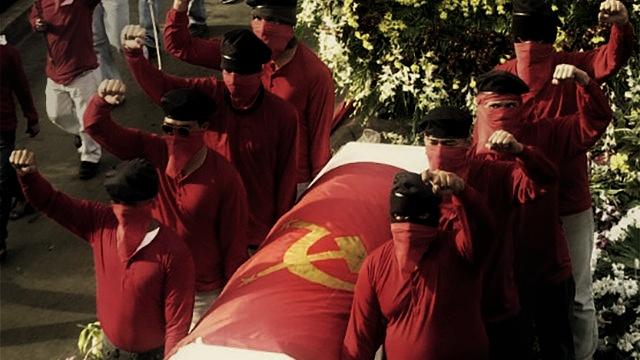
Martyrization confers meaning on the present by writing backward onto the dead. Every martyrology, including communist martyrologies, performs this. Red drapery does not exempt the corpse from the retrograde structure of its own curation.
XX
Yet the struggle that alone could accomplish real redemption produces its dead now, under conditions in which the debt cannot yet be paid, and the meaning-apparatuses of class enemies curate the corpses regardless of any scruple about purity. Abstention from martyrization is not neutrality; it is default, the unforced surrender of contested terrain to whichever apparatus is least troubled by the vice of retrograde meaning-making.
XXI
The Communists belong to a historical party as its living cells. The lesson of the Commune in regards to the existing state machine outlives every communard’s biography and needs none of them worshipped to remain true; the same goes for other militants of revolution, whom we recognize not by name, but by a fidelity to its anonymity. The party is a living organism whose cells are its militants, persisting through their metabolism. No cell needs to have known the whole in order for the whole to know itself through the sum of the cells’ activity for the coherence belongs to the organism.
XXII
Bourgeois history is an image of the great relay, in which a baton is carried by a sequence of individual hands, each known, remembered, and eventually credited, and it is this relay that produces the veneration of whichever hand is judged to have carried the baton furthest. The red thread of communist struggle, woven continuously through material scattered across many places and manufactured without interruption from a single unbroken source, requires no such accounting; it does not matter whose labor spun which foot of it so long as the thread itself never breaks.
XXIII
Death is not just the event of negation of a bounded thing but the determinate negation of form of matter that was never ensouled as such. The organism that fears its own ending venerates its ephemerality as a permanent boundary, when in fact what it calls itself is but a provisional configuration that will recompose, on its dissolution, into other configurations, other sensibilities, other lives. The dread of death is not effaced by merely discovering its historicity, but only by the supersession of the conditions that produce it. Communism inherits no ready-made relation to death from any prior community but must produce one, and can produce one only by abolishing the separation that makes death catastrophic, which is to say: it cannot be found, only made.
XXIV
Class society forces us to the ugly conclusion that martyrs are inevitable. There is no position outside this war from which to judge the dead, innocent of their own curation, and no purity available to those who fight it. What the living owe the dead of the struggle is neither martyrdom’s affirmation nor the convenience of amnesia, but to become heirs of a method and orphans of every name. Communist martyrdom is no exception to the fetish of valorized-death.
XXV
The corpse is a cold surface and the world a frantic scribe. Stories will be etched into the stillness of our comrades, legends accrue like sediment, whether we lift the pen or lay it down. The distinction of Communist martyrdom lies not in an impossible immunity to martyrization, but that this relentless self-interrogation become a living organ within the body of Communist practice. The party of the Communists preserves the dead only insofar as their remembrance serves the abolition of the conditions that made martyrdom necessary, to ceaselessly dissolve every impulse to let sacrifice harden into a solemn religion of bones. Alone among the warring belligerents of this earth, the party of Communism does not dream of making martyrs eternal, instead fighting to bring about the conditions to make them unnecessary. The proletariat, which has no fatherland, can in the end afford no martyrs either, only the dead it has not yet finished avenging through the sole act capable of class-vengeance—the making of a world in which no death need mean anything beyond itself.