see-n●thing

Category: Marxism

  • The State after History

    The State after History

    Workers ought not to be exclusively absorbed in these unavoidable guerilla fights incessantly springing up from the never ceasing encroachments of capital or changes of the market. They ought to understand that, with all the miseries it imposes upon them, the present system simultaneously engenders the material conditions and the social forms necessary for an economical reconstruction of society. Instead of the conservative motto, ‘A fair day’s wage for a fair day’s work!’ they ought to inscribe on their banner the revolutionary watchword, ‘Abolition of the wages system!’

    Karl Marx, Value, Price, & Profit.

    Between the 1950s and the early 1970s, much of the global periphery entered what appeared to be a decisive historical window. Manufacturing output in several late-industrializing economies grew at annual rates exceeding 7%. Public investment routinely crossed 25% of GDP. State-owned firms dominated steel, energy, transport, and telecommunications. Tariff walls averaged above 40%, capital controls were tight, and labor absorption, while uneven, moved in the right direction. Rural populations were displaced, but they were displaced into factories, ports, and construction sites rather than into permanent surplus. Against the boomer (including boomer-adjacent gen X) nostalgia, this was far from a golden age, though it may have been at some point within the social caste, but it was a coherent one. The state had a clear function: to force capital accumulation where it would not spontaneously occur, and to subordinate competing class interests to the nation-building project.

    Rather than all at once, that coherence collapsed in stages. By the late 1970s, profit rates declined, import substitution hit technological ceilings, and external financing replaced internal surplus as the main driver of investment. Debt rose several times faster than output. Manufacturing employment plateaued, then fell, even as output figures continued to climb. Neoliberal structural adjustment inaugurated the model’s total exhaustion. When trade was liberalized and finance opened, it became clear that national accumulation had been overtaken by a global system organized around monopolized technology, concentrated capital, and mobile value chains, in accordance to the Washington Consensus. It was a rupture from the old forms of capital accumulation, and it meant a rupture from the old ways of class struggle in both camps of the world-bourgeoisie and the international proletariat. The state survived this rupture, but in irreversibly altered form. Its coercive, exploitative, managerial instruments remained, yet with their formal purpose shifted from building productive capacity to managing the constraints it encountered in the global market, in the birth pangs of integration and restructurations. Herein unfolds the sharpening intra-class struggle between the two domineering fractions of capital: the nationalists, and the globalists.

    The present inherits this outcome without acknowledging it. Industrial policy retains relevance only in the forms of subsidy, tax incentive, or infrastructure for circulation. Growth resumes on paper while employment stagnates. Ports expand faster than factories. Logistics outpaces production. Credit replaces wages as the means of social reproduction. What looks like real development is instead an emptied rehearsal for a stage which seemingly disappeared out of nowhere. The modern state can only plan adjustment; it intervenes today only to stabilize conditions it no longer controls.

    This is the political atmosphere of the periphery today where the state presides over the modernization of mal-development. The developmental state depended on an expandable world market, relatively low technological barriers, and the possibility of absorbing labor into national circuits of accumulation. In the Philippines, manufacturing output has since the ‘70s grown intermittently, its share of employment steadily plateauing. Infrastructure spending has surged, primarily in transport, energy, and logistics, not in productive (ie., self-sustainable) development. Export zones multiply while domestic supply chains thin. Growth figures in cloud spreadsheets coexist with chronic underemployment, mass migration, and household indebtedness on the ground. The state remains active and visible, but its activity increasingly mediates between global capital and surplus labor rather than organizing accumulation in its own right. The peripheral capitalist state today operates after history.

    False antagonisms

    As national accumulation loses coherence, capital fragments into competing fractions whose interests diverge at the level of strategy, scale, and geopolitical-spatial anchoring. In the periphery, this division commonly appears as a conflict between “national” and “transnational” capital. This internal dialectical contradiction structures new norms of bourgeois political life, from electoral competition to much of the left’s strategic horizon derived from an already-derivative political imagination. Insofar as both fractions operate within, and reproduce, the same post-developmental constraints of imperialism, we have no more than a false antagonism—false, precisely because this doesn’t sublate the antagonism between the bourgeois and the proletarians. On the contrary, the exhaustion of developmentalism has only sharpened it, at the same time as it sharpens the competition within the respective classes themselves. The conflict between these two fractions of capital concerns how to manage their respective integrations into world-imperialism, whose friction is the permanent tendency to re-divide the earth and the spoils of crisis.

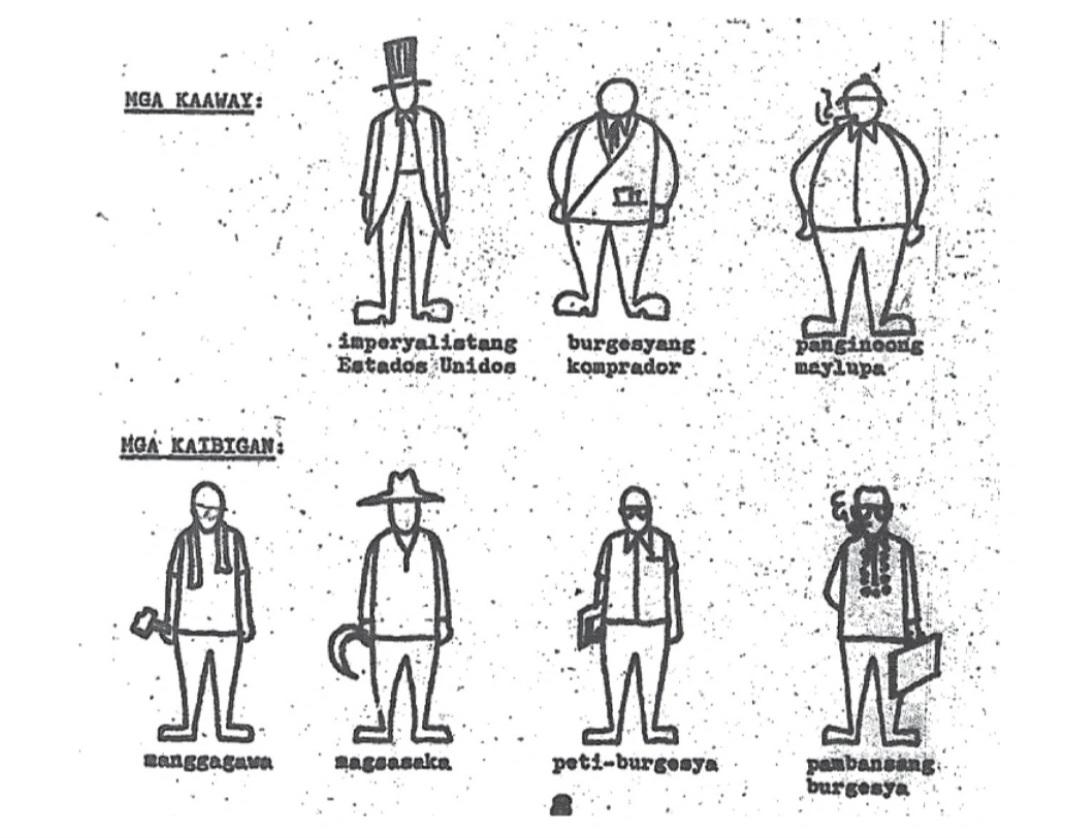
    CPP’s Drowing: Tulong sa Pagtuturo; pulled from Joseph Scalice’s article, “55 years since the founding of Kabataang Makabayan (KM)”.

    National capital in the periphery is no longer what it was during the classical developmental (ie., “Fordist”) period. No longer is there an emergent industrial bourgeoisie struggling, that is, actively intervening, to consolidate domestic production against emerging foreign competition. It is now a heterogeneous, only semi-coherent bloc of construction firms, real estate developers, logistics operators, agribusiness interests, utilities, retail conglomerates, and politically-connected rentiers (landlord-capitalists, compradores). Its accumulation strategies are territorially fixed but structurally dependent. Profitability derives from state contracts, land conversion, naked corruption, monopoly concessions, and access to credit, rather than from sustained industrial development. This fraction requires the state only insofar as the monopolized-hence-totalizing violence at its behest continues to be a guarantor of rents, regulator of political access, and disciplinarian of labor, whether through state and yellow unions or through direct violence.

    Transnational capital, by contrast, is characterized less by all the baggage that comes with national identity (including its peripheral role, say, in the Philippine case, as a “service economy”, or reservoir of cheap migrant labor) than by function. It operates through transnational value-chains, monopolized technologies, and financial mobility. Investment decisions made by this fraction are driven by cost-differentials, logistic efficiency, and risk management in lieu of long-term commitments to national development or, more appropriately, short-term rent-seeking through patronage networking and dynastic turf-building. In the periphery, transnational capital enters primarily through export-oriented manufacturing, which entails the development of extractive industries, infrastructure finance, and services (accessory to circulation). Its demands on the state are selective but consequently (unconscious or otherwise) potently subsumptive: stable macroeconomic policy, flexible labor markets, legal safeguards, and infrastructural connectivity, all of which become anchor-points for domestic capitalist development (ie., integration). It has little interest in national industrial development beyond what is immediately profitable, though competition may at times compel it to invest more than it would have preferred to in order to gain an advantage and guarantee returns.

    In the Philippines, large domestic conglomerates like Ramon Ang’s San Miguel Corporation dominate construction, energy, transport, and real estate. Their profitability is tightly linked to public infrastructure programs, land re-zoning, and regulatory privilege. At the same time, export-oriented manufacturing, business process outsourcing (BPO), and logistics depend on foreign direct investment, trade liberalization, and integration into global accumulation networks. State policy can only alternate between courting foreign capital and appeasing domestic elites to ensure they get their piece. Infrastructure spending expands primarily to facilitate circulation (and line bureaucrat pockets) rather than to develop domestic productive capabilities.

    Domestically, one of non-industrial development’s pillars is the marked resilience of the landed bourgeoisie. Unlike in South Korea and Taiwan, where US-backed land reforms in the 1950s dismantled the landed bourgeoisie as a political force, freeing capital, cultivating a domestic market, and removing a reactionary bloc to state-led industrialization, the Filipino landed bourgeoisie successfully neutered every reform effort since the granting of the country’s nominal independence from the US in 1946. They seamlessly translated agrarian monopoly into commercial, financial, and later industrial capital, creating an oligarchy whose wealth derived from political rent, monopoly control of domestic markets, and comprador partnerships, in lieu of productive export competition. The Philippine state never achieved the autonomy of South Korea’s Economic Planning Board; it has remained, and today remains, a captured apparatus for middle-manning oligarchic and crony competition. Industrial policy, where it existed, served as a tool for dispensing protected rents to favored factions which only cemented a consumption-oriented Import-Substitution Industrialization (ISI) model, in contrast to the Newly-Industrializing Countries’ (NICs) export-oriented ISI.

    Externally, the Philippines lacked the geopolitical weight that granted the NICs their critical edge. South Korea and Taiwan operated under a US security umbrella that provided not only aid but also unparalleled market access and tolerance for the very protectionist and subsidy policies now prohibited under WTO rules. This permitted a decades-long period of “infant industry” protection simultaneously forcing discipline through export targets. The Philippines, while a treaty ally, was never the recipient of such concerted, strategically motivated industrial nation-building, instead predetermined to become by then a source of raw materials for external industrial processing and manufacture. By the time it might have attempted a belated developmental push, the global institutional environment had since ossified and settled. Binding commitments to the WTO, ASEAN trade pacts, and bilateral agreements locked in liberalization, prohibiting subsidy programs, local content requirements, and strict capital control systems that defined the NICs’ protectionist, export-oriented industrialization model.

    Thus when the current global system of monopolized technology and fragmented value chains fully emerged, the Philippines was uniquely predisposed to integration as a dependent node. Its manufacturing sector, historically nurtured for the domestic market, could not compete in high-value exports, thoroughly crushed by the opening up of the domestic market to foreign investors and competition, whose wares had much higher quality for cheaper prices for consumers. The oligarchic economy adapted by specializing in rents from logistics, real estate, mining, and low-value assembly within global value chains tasked with semi-processing electronic assembly and producing automotive parts, aside from raw material extraction. The state’s function adapted accordingly; its “industrial policy” narrowed to providing tax incentives and building infrastructure for circulation (ports, highways, power-grids) to facilitate this integrative role. Catching up in steel, ships, and basic electronics in the 1970s was difficult but, with the greatest global superpower in history backing your development for its imperialist business interests, feasible through reverse-engineering, incremental innovation, and near-unlimited investment capital. Today, breaking into monopolized sectors like semiconductors, aerospace, or pharmaceuticals requires R&D investments and scale that are orders of magnitude greater, protected by intense intellectual property regimes (see: TRIPS Agreement). Any residual nationalist impulse is structurally checked by the impersonal disciplinary power of hyper-mobile finance capital; capital controls or directed credit would trigger immediate capital flight and credit score downgrades from agencies like Moody’s and S&P.

    The “political will” necessary for developmentalism would require the native bourgeoisie to will its own transformation from a myopic rentier-comprador class into a risk-taking industrial bourgeoisie, while simultaneously defying the hard constraints of a fully-globalized capitalism. Their wealth derives from rents (land, real estate, monopolies in utilities, mining concessions, retail), political patronage (state contracts, protected sectors, dynastic lineages and bulwarks), and comprador activities (importation, franchising, representing foreign brands). Industrial deepening is risky and offers lower returns than rent-seeking in the short-term, with no guarantee of eventual profit in the long-term due to overwhelming competition. Their interests are aligned with liberalization (to access cheaper imports for their businesses) and, ultimately, financialization. Perhaps this is indeed a lack of will, but it is also, in the first instance, conditional of the shaping of this will, a structural impossibility. While the state appears to stand atop society, piloting it from the cockpit, it is nothing more than the condensation of a totalizing social formation oriented towards chronic dependency.

    The conflict between these fractions is of course real, and a source of much of the crises being suffered through by proletarians (semi-proletarians included) in the peripheries, but it is ultimately bounded by the hard constraints of the imperialist world-system. National capital seeks protection, subsidy, and preferential access where transnational capital seeks liberalization, deregulation, and maximum capital mobility; both require the state; both rely on surplus-labor and the violent consequence of inter-class competition among proletarians; both operate within a global system that constantly delimits their strategic horizons. The state becomes the terrain on which this conflict is mediated, where these manifolds of determinations converge and find resolution (or, attempts at such). Policy oscillates between nationalist rhetoric and globalist accommodation, between promises of sovereignty and commitments to competitiveness and bilateral trade agreements. These oscillations are often interpreted as ideological incoherence or political opportunism when, in fact, they reflect the structural impossibility of reconciling developmental aspirations with the contemporary organization of capital as a planetary “substance” of social life. What tends to happen is the hollowing-out of whatever is left of national-developmentalist aspirations of the native bourgeoisie, reduced to what is effectively political veneer, as the inevitable march of the Juggernaut that is capital’s transnationalization, in its historical quest of alienated homogeneification, crushes and subsumes local production processes from the inside and crushed under its weight.

    This configuration produces a specific form of brutality: workers are disciplined in the name of competitiveness without being integrated into stable industrial employment; infrastructure projects displace communities while creating limited long-term jobs; export zones offer employment under conditions of precarity; national capital extracts rent while deflecting responsibility for the deficit in social reproduction onto semi-proletarian households, OFW migrants, and informal economy networks. All the while, transnational capital secures its surplus while externalizing risk to the peripheral state, who mediate these processes through absorbing political blame, ultimately powerless, in the name of the law of value, to overturn the underlying logic of the world.

    Conserving what’s lost

    Reactionary movements arise from the disjunction born of post-war developmentalist capitalism, for both the core and periphery/semi-peripheries alike, depending on one’s determinate position within the world-system. They respond to declining job security, wage stagnation, housing precarity, eroded welfare, and increased market volatility. These conditions are experienced as loss of stability and a future of class mobility for the working and middle classes. In the core specifically, because global capitalism cannot be confronted through national political mechanisms, this apparent “decline of Western civilization” is interpreted as betrayal and conspiracy by elites, outsiders, or cultural enemies; here, declining industrial employment collides with residual welfare capacity and imperial rents, which seems to produce a defensive (ie., “right-wing”) nationalism oriented toward restoration of some past privilege or historical glory. In the semi-periphery, export-dependence and wage suppression, intersecting with integrationist projects (eg., European Union) which are perceived as threats to national identity, generate authoritarian stabilization projects that promise order and compensation through identitarianism with little material redistribution. In the periphery, where welfare and employment never stabilized social reproduction, political reaction more often takes the form of left-nationalist or moral anti-imperialism motivated by subsistence struggles. Reactionary politics reorganizes consent under conditions where no national (ie., traditional, known, immediate) solution to material decline exists.

    In the United States, The MAGA movement, also increasingly apt as Trumpism, developed out of decades of deindustrialization, union defeat, and labor-market fragmentation. From the 1970s onward, manufacturing employment declined while production was reorganized through offshoring and automation. Wages stagnated while productivity levels and profit-rates shot up to the sky. Social reproduction increasingly relied on credit and what little welfare, bureaucratic as it is, existed. The promise that globalization would compensate for these losses ultimately failed to materialize in the quality of life of the working class. MAGA, or Trumpism, frames this experience as the outcome of unfair trade, immigration (legal or illegal), and conspiring cabals of liberal elites. Its policy proposals of imposing absurd tariffs, border enforcement and internal purging of immigrants, and quasi-protectionism, are all attempts to roll back the present to the collapsed horizon of post-war, pre-neoliberal accumulation. Trump dresses himself as presenting the American working class what Reagan has denied them in the neoliberal turn: an “alternative” to globalization, to neoliberalism, to imperialism, to sickness, starvation, and death. Merely that, as time passes, Reagan has only been vindicated, at the cost of our class’ suffering, and Trump has only been revealed as the thoroughly bourgeois opportunist politico-businessman he has been all this time. To call him a prophet of neoliberalism would be improper, since in reality he only declared what was already by then a truth of the capitalist world: “There is,” truly, “no alternative.”

    Similar dynamics appear in Europe in different institutional forms. The rise of the AfD (Alternative für Deutschland) in Germany for one is inseparable from an export-led growth model based on wage suppression and labor market dualism it adopted in 1990. The Hartz reforms stabilized German competitiveness in the world-market by shifting adjustment costs onto workers and peripheral European economies. Aggregate growth reflected in corporate profit-rates across the board coexisted with precarity and declining public welfare; the AfD effectively channels consequent discontent toward the European Union, migration, and multicultural liberalism, the party itself remaining largely neoliberal, openly in support of deregulation and state non-intervention, in its economic positions. In France, Italy, and other parts of Southern Europe, reactionary movements draw support from regions affected by deindustrialization, austerity, and long-term unemployment. In Eastern Europe, Rightist regimes (eg., Fidesz–KDNP Hungary, PiS Poland) consolidate power within economies integrated as semi-peripheral manufacturing zones. Growth occurs through foreign investment, low wages, and limited technological upgrading. Living standards lag behind core economies, emigration drains labor markets, demographic reproduction weakens. These nationalisms attempt to compensate for economic dependency by asserting cultural sovereignty and political control.

    In Indonesia, post-Suharto democratization coincided with the deepening of market liberalization and decentralization. Accumulation is, not unlike much of Southeast Asia, structured through extractive industries, logistics, and low-wage manufacturing tied to global value chains. Among the results we observe today are regional inequality, labor precarity, land dispossession, and youth underemployment. Street riots and episodic mass protest-mobilizations are time and again incapable of articulating a coherent alternative project and instead function as release-valves for social pressure, relapsing onto bourgeois forms of political mediation and resolution. In Bangladesh, garment-sector uprisings, joint worker-student revolts, and urban unrest arise from extreme export dependence, hyper-exploitation of labor, and the collapse of rural reproduction. In the face of wage stagnation and union suppression amidst recurring industrial disasters, growth rates remain nominally high. Insurrection here targets immediate conditions of survival. Unlike in the imperial metropolises and semi-peripheries where protectionist, identitarian ideology and Volkisch consciousness are the dominant media of obfuscation and confusion against class struggle, here, in the peripheries, the material limit of subsistence struggles act as the basis and multiplier of left-wing nationalist “anti-imperialist” ideology to serve the same purpose.

    Duterte’s administration in the Philippines expanded infrastructure spending, deregulated foreign investment, protected export enclaves, and preserved labor flexibilization. The drug war and militarization functioned as instruments of social discipline in a context where stable employment was never a guarantee nor a norm and welfare was pork barrel. Populist violence in the war on drugs and against activist civil-society was the Spectacular cover for his administration’s discovered failure to overcome structural constraints and facilitate real development. Against his performative hostility to the US and flirtations with China, the Philippine economy remained just as embedded in transnational circuits of capital, logistics, finance, and labor export—circuits which tie the Philippines inevitably to the US by a thousand chains. Manufacturing continued to stagnate in employment terms; growth remained dependent on remittances, real estate, construction, import-dependent consumption, and export-oriented services. Infrastructure projects under “Build, Build, Build” were mere accessories to circulation and chronic (inter-)dependency (importation, exportation). Meanwhile, Marcos Jr.’s pivot-back to Washington, reaffirmation of trade liberalization, courting of foreign direct investment, and the emphasis on macroeconomic stability is the normalization of the same trajectory behind a “calmer”, more investor-friendly facade. In this situation we might say Duterte represents nationalist capital while Marcos represents globalist capital, both fundamentally deadlocked on the same world-integrating trajectory underneath their superficial ideologies and proverbial boxing matches in the national government and International Criminal Court.

    Limit-points of praxis

    To much of our dismay, the crisis of development does not automatically generate a mass revolutionary politics. It encourages, instead, for an interim period, the persistence of political forms whose material underpinnings have already been eroded by the unceasing, indiscriminate march of capitalist “progress”. These forms retain relevance at the level of ideology and organizational habit, but, owing to a blindness to path-dependency, they operate within a historical terrain that no longer corresponds to their professed strategic goals. We must locate the precise points at which their internal logic encounters the objective limits of global capitalism.

    Nationalist Developmentalism: Classical developmental strategies presuppose (and, for a time, really encountered) a state capable of acting as a centralized organizer of accumulation. This capacity rested on three determinations: (1) partial insulation from global capital flows, (2) an ability to discipline domestic capital fractions, and (3) the expansion of productive sectors, preferably industrial-manufactory, capable of absorbing the excesses of proletarianization in the countryside. In today’s periphery, not one of these remains. Capital mobility constrains fiscal, monetary, and industrial policy; domestic capital increasingly derives profitability from state-mediated rents, logistics, and speculative activity rather than productive reinvestment; labor absorption is structurally blocked by technological monopolization and the fragmentation of production at the world-scale. Political strategies that treat the state as a lever for national development misidentify its actual role within global value relations. The conditions we encounter today only confirm to us that capitalism is not a social phenomena enclosed (or truly encloseable) within a coherent nation-space.

    This defines the structural limit of nationalist praxis, in presupposing that political sovereignty can be converted into economic autonomy. Under present conditions, that is, of “neo-colonialism”, “semi-colonialism”, “dependency”, “peripherality”—what have you—sovereignty is mere shiny-white veneer for decomposing teeth; peripheral states retain discretion over taxation, repression, infrastructure-siting, and regulatory enforcement, but these capacities operate within a field already subsumed and determined by transnational capital. Protectionism has run its course; liberalization only deepens not just dependence (one-way relationship), but interdependence. Nationalism can only persist as a specifically reactionary political form in the 21st century precisely because its economic content has long since been hollowed-out. The considerations on the immense task of class conciliation, on the question of political will, to prioritize nation-building can only take the form of a Corporatist state which pegs down the landed bourgeoisie, cultivates the industrial bourgeoisie, prioritizes the welfare of the middle-classes, and violently subordinates the labor movement, rural and urban, to the interests of the collective “producers” of the nation. We are, to say the least, not interested in the economic models of Fascism, of National Syndicalism, of National Socialism, even when the masses look to Lee Kuan Yew’s Singapore, Marxist–Leninists look to the Jucheist DPRKorea, among other “actually-existing” Socialisms, and Social Democrats look to China as ideal-types.

    Social–Democratic strategies: Social–democratic and populist strategies assume that reforms can accumulate over time and gradually strengthen the material power of the working class. This assumption was predicated on a historical situation in which productivity growth, employment expansion, and welfare reinforced one another. That situation no longer exists. Today, reforms operate within tight structural limits as a zero-sum game where wage gains are offset by precarious work, subcontracting, and household debt; social welfare programs rely on regressive taxation or borrowing and hence reproduce fiscal vulnerability in lieu of stabilizing social reproduction; participation in democratic institutions integrates organizations into state management without expanding their independent capacity to confront and interrupt capital accumulation as such. Social–democratic reformism presupposes that these conditions persist in attenuated form and can be reactivated through redistribution, institutional inclusion, or policy correction.

    Counter-hegemony: Counter-hegemony, as famously theorized most systematically by Gramsci, later generalized across the Left, begins from the premise that capitalist domination is primarily stabilized through civil society; culture, ideology, institutions, norms, and consent. Power is exercised less through direct coercion than through the organization of meaning and everyday-life. From this follows a strategic orientation in which the revolutionary task is to construct an alternative hegemonic bloc within existing society prior to rupture. The party of counter-hegemony, posited as an independent revolutionary subject external to or insulated from bourgeois society, treats capitalism as a malleable social order whose contradictions can be neutralized or displaced through cultural struggle, rather than as a totalizing mode of production governed by invariant laws. Counter-hegemony assumes that civil society can be occupied independently of the capitalist relations that structure it—in this insight we glean that Gramscian counter-hegemony operates on the same theoretico-practical register as Social Democracy.

    In reality, the party is an autoreflexive organism which identifies its origin point from the dynamics of class struggle under bourgeois society itself, and becomes class struggle’s function, in full awareness that those pressures will act on it continuously. This is why it necessarily minimizes sociological embeddedness, cultural work, and alliance-building a la bourgeois political party-building. The more the party embeds itself in civil society, the more it is compelled to speak its language. From the structural lens, counter-hegemonic projects reproduce themselves through recognition, funding, and procedural legitimacy rather than through disruption of accumulation. They assume a more-or-less workable continuity of counter-hegemonic power-building along a stable axis of temporality while capitalism in the periphery is governed by abrupt shocks, crises, and permanent geopolitical uncertainties. This means that when political openings appear, they do so suddenly and close quickly.

    In geopolitical terms, counter-hegemony in the current order means multilateralism. Multipolar or “counter-hegemonic” strategies that oppose US unipolarity through BRICS alignment or China-led “socialist multilateralism” identify imperialism as a geopolitical configuration composed of competing, semi-independent national economies that create an emergent “world-capitalism” in interdependence, rather than as the specific form of capitalism at the world-scale. US dominance is posited as the invariable cause of underdevelopment instead of simply being its historically-contingent organizer. Replacing a unipolar order with a multipolar one reorganizes competitive discipline over the same world-market, governed by monopolized technology, financialized accumulation, and integrated value-chains. Peripheral states remain structurally compelled to attract capital, suppress labor costs, and specialize in low-value segments of production. There is nothing special about, say, Chinese capital that can suspend these imperatives.

    Multipolarity can only intensify inter-imperialist competition while narrowing room for maneuver as peripheral states are locked into overlapping dependencies. By framing development as alignment against a dominant imperial pole, it subordinates working-class interests to state and capital strategies in the moral language of anti-imperialism. Labor discipline, repression, and austerity are justified as necessary for positioning within a hostile global order. Class struggle is displaced upward into diplomacy and industrial policy while exploitation intensifies at the point of production.

    Finally, each of these forms of praxis attempts to resolve capitalist contradictions through mediations that presuppose the continued reproduction of capitalist social relations. Nationalism seeks to re-territorialize accumulation where reformism (whether Social–democratic or Gramscian) seeks to plaster into it a friendly, human smile. Both operate by narrowing the field of political imagination to what can be administered by the state, displacing conflict away from the relations of production and reproduction that generate crisis. When these strategies inevitably fail, the resulting disillusionment has historically weakened class autonomy and opened space for retaliatory, violent counterrevolution. In either case, capitalism is treated as a system whose limits can be negotiated rather than abolished whether explicit or otherwise to their proponents. The historical trajectory of the periphery since the 1970s indicates that these negotiations now occur entirely within the permanent management of permanent crisis.

    Remarks

    The working class in the periphery is no longer unified by stable industrial employment or national circuits of accumulation. Its passive condition as variable capital is that of a “unity-in-separation”, fragmented across formal and informal sectors, production and circulation, domestic and migrant labor, nationalities and cultures, regions and religions. Organizational forms developed within earlier terrains of class struggle are incapable of unifying the segmented class because their mediations which presupposed stable points of leverage simply no longer exist. At the same time, the hollowing-out of developmental accumulation generates a contradictory opening. As the state loses its capacity to integrate labor, its legitimacy consequently erodes. And as accumulation fails to absorb surplus populations, struggles increasingly target immediate conditions of reproduction. These struggles tend to be localized, episodic, and oriented toward survival rather than reform. They do not, in themselves, constitute a revolutionary movement but do, however, indicate a shift in the locus of antagonism, away from mediated demands and toward direct confrontation with the political conditions imposed by capital.

    For a communist critique, the task is, as it has always been, to expose world-capitalism’s limit-points. If national accumulation can no longer integrate labor, the terrain of struggle shifts accordingly. Conflict concentrates around social reproduction, circulation, subaltern surplus populations, and state violence rather than wages and industrial policy alone. Housing, transport, food, energy, debt, migration, and policing become central sites of antagonism. These struggles are fragmented and episodic, but they are not marginal. They reflect the real points where capitalist reproduction now encounters a steady resurgence of class resistance.

    The antagonism between nationalist and globalist capital delineates the field within which crisis, one of which being that of “development”, is managed; the state bears the scars of preceding proletarian struggles; and recognizing this is a precondition for breaking with strategies that seek salvation in national accumulation. We must, therefore, confront that which renders the state incapable of transformation.


    Relevant references
    • John Smith, ‘Imperialism in the Twenty-First Century’
    • Alejandro Lichauco, ‘Nationalist Economics’
    • Philippine Review of Economics. ‘Special Issue on Industrial Policy’. Vol. 61, No. 02, December 2024.
    • Hassel, Anke & Di Carlo, Donato. (2025). Germany: Adjustments of an Export-Led Growth Regime.

  • Fragments on Invariance

    Fragments on Invariance

    Personal reflections and notes on the invariance of Marxist doctrine and method, as elaborated in the tradition of the Communist Left

    The materialist denial that a theoretical “system” that had arisen at a particular moment in time (and, worse yet, one that had arisen in the mind and took shape in the works of a particular man, a thinker or historical leader, or both at the same time) could irrevocably apply to the whole course of the historical future, its rules and its principles, must not be understood in the sense that there are no stable systems of principles that are applicable to very long stretches of historical time. To the contrary, a system’s stability and its powers of resistance against being mutilated and even against being “improved”, constitute a primordial element of the power of the “social class” to which that system pertains and whose historical mission and interests it reflects. The succession of such systems and bodies of doctrine and praxis is not connected with the advent of men who define the stages, but with the succession of “modes of production”, that is, of the varieties of the material organization of life of human collectivities.

    Amadeo Bordiga, Milan’s Theses no. 5 (1952)

    Communism is for us not a state of affairs which is to be established, an ideal to which reality [will] have to adjust itself. We call communism the real movement which abolishes the present state of things. The conditions of this movement result from the premises now in existence.

    Karl Marx, The German Ideology (1845).

    [1] The stable foundation of the entire Marxist political edifice is a specific understanding of capitalism as a global mode of production. For the Marxist Left, following Marx’s critique of political economy, capitalism appears to us as a closed, antagonistic totality that shapes all spheres of life, an “organic system” whose parts have no independent meaning outside of their function within the whole. This totality possesses an internal, logical consistency operating according to historically determinate laws, foremost among them the law of value and the exploitation of labor-power to produce surplus-value. This systematic character is global from its inception; capital, in its imperialist height, subsumes every corner and exhausts every frontier of the globe, creating a unified, if hierarchically structured and internally stratified, world market. At the heart of the capitalist mode of production is the capital-labor tension, substantially, the tension between the forces of production and relations of production, embodied in the structural determinations of political and economic struggle between workers and capitalists. The class struggle between the proletariat and the bourgeoisie, wherever they may find themselves in, is a singular world-historical conflict from which only two existential-civilizational possibilities emerge: the common ruin of the contending classes, and the advent of communism. The proletariat itself exists, with both its feet in two worlds at once, as a global class, both as statistical variable capital within the international circuit of production, as a “class in itself”, and as the potential revolutionary subject negating that circuit, as a “class for itself”, containing, in its activity, the possibility of communism.

    [2] The caveat is that this appearance of capitalism as a fully stable, self-enclosed totality is exposed to us, although in partial ways corresponding to our determinate position within the whole, as ideology unmasked by capitalism’s own internal instabilities, manifest in crises across the board (social, political, economic). From this conception of capitalist totality springs the principle of invariance. Contra the popular dismissiveness of intellectualists against this glue which coheres Marxism, invariance is not the dogmatic adherence to the holy texts of Marx, Engels, Lenin, Bordiga, or some other set of names, neither even exegetical consistency nor the specific tactical prescriptions of a given historical moment, but the fundamental method and core principles derived from the analysis of capitalism’s unchanging logical structure, continually reaffirmed in each cycle of class struggle.

    Communism is indeed, as Marx insisted, the “real movement which abolishes the present state of things”, thus this abolition must first be grounded in the determinate content of the “present state of things”. Invariance is that horizon which grounds the activity of abolition to the capitalist mode of production itself. If capitalism is a global system with an identifiable, coherent, internal logic, then the political, ultimately social, response necessary to abolish it must itself possess an internally coherent, logically deducible, if negative, core. The content of this invariance is discovered through the historical experience of the proletariat engaged in struggle, principally through its defeats. Each major historical defeat of the workers since 1848, the Paris Commune, the betrayal of German Social Democracy in 1914, hollowing-out of the Soviets in 1921, the Stalinist degeneration in 1926, Fascism in Italy and National Socialism in Germany, World War 2, Paris 1968, and innumerable struggles up to this day do not give us positive prescriptions for victory, rather negative, prohibitive theses: what must not be done and what lines must not be crossed to avoid the integration of the proletariat and the dissolution of its doctrine into bourgeois civil society.

    Invariance is not the systemization of ideas of particular great men in history but of the sedimented content of the communist program itself baked into the very substrate of capitalism. The claim is simple: capitalism has fundamental unchanging foundations which makes it capitalism, which allows us to identify it as capitalism throughout all its forms in the history of bourgeois society, which then allows us to produce a systematic, immanent critique of capitalism as such. The communist program is the political remainder of that critique; invariance is that continuously reconfirmed core of negative determinations whose validity rests on the persistence of capitalism’s fundamental relations, reaffirmed and re-established through concrete, painstaking analysis in each new historical conjuncture.

    A brief detour on mathematical invariance

    Jean-Pierre Luminet, 1978

    Mathematical invariance identifies some persistent determinate property under a defined class of transformations, such that an object’s identity is secured by those structural relations that remain unchanged across alterations in form. Suppose you have an object or an equation, which you decide to rotate, stretch, or swap its parts around according to some given set of rules. An invariant is a characteristic or a quality that stays exactly the same despite these alterations. It is a relational criterion that presupposes variation elsewhere and becomes meaningful only in reference to transformation, and not some metaphysical immutability of that object’s properties. In algebra, for instance, the determinant of a matrix is an invariant; no matter how you change the coordinate system, this single number captures something essential about the transformation the matrix represents. Objects are equivalent insofar as they share the same invariants within a given transformation group.

    This logic extends into physics through the concept of symmetry. Emmy Noether’s first theorem demonstrated that every continuous symmetry of a physical system corresponds to some conserved quantity: time-symmetry yields conservation of energy; rotational symmetry yields conservation of angular momentum. The formalization of invariance within group theory makes explicit that invariance is always indexed to a determinate set of transformations, and that objecthood itself is defined by the relations preserved under those transformations. In this sense, invariance does not describe what an object is in itself, but determines the criteria by which its identity is maintained across systematic change. It is precisely by abstracting from representational diversity that mathematics isolates essential structures which is necessary for grounding analysis in stability under transformations.

    The search for invariants is a search for the permanent, essential “truths” within a system, providing a stable framework to understand the nature and consistency of change. Marxism, in its historically specific register, operates analogically by seeking to identify those structural determinations of capitalist society (its object) that persist across its changing political, institutional, and ideological forms in the unfolding of class struggle, as the invariant relations which necessarily define the horizon of communism.

    [3] The bedrock of all invariant principles of communist politics is unconditional class independence. This was the most valuable lesson of 1848, where the proletariat, fighting on the terrain and for the objectives of the democratic anti-feudal bourgeoisie, was isolated and crushed once that bourgeoisie achieved its aims, and has only been re-confirmed with remarkable consistency ever since.

    Class independence asserts that the proletariat cannot achieve its historical mission through alliances with any fraction of the bourgeoisie, no matter how “progressive”, “anti-imperialist”, or “democratic”. Such alliances subordinate proletarian interests to bourgeois ones, channeling revolutionary antagonism into the restructuration, reinforcement, and continual perfecting of capitalist social relations and methods of counter-revolution in modernized and oppressive forms. This principle is invariant because, first, the fundamental class antagonism between wage-labor and capital is invariant; any political form that blurs this antagonism, from popular fronts, to national liberation movements, to interclassist “people’s democracies”, is therefore a counter-revolutionary trap. Second, it is precisely because democracy, that mystification of class divide through universal suffrage and abstract individual freedom, that formalization and institutionalization of the working class’ political integration into capitalism, is the bedrock of capitalist society, that class independence is its negative image.

    Other invariant principles logically flow from this: the rejection of the parliamentary road as a strategy for socialism, the refusal to confound the conquest of the existing State machine with the communist revolution (the State being the inherently conservative and reifying structural condensation of bourgeois social relations), and the non-negotiability of internationalism. These are not arbitrary tactical preferences or abstract ethico-moral universal principles pulled out of the asses of Enlightenment or modernist political philosophy geniuses but strictly logical deductions from the consistent nature of the enemy and the concrete suffering of our class under capitalism. They are therefore as inflexible as the laws of capital.

    [4] When we speak of communism as a “stateless, moneyless, classless” society, we intuit that the communist program is an inverted picture of capitalist society, but that the categories proper to the capitalist mode of production are inadequate to capture the positive dimension of communism (that is, of communism in its “highest phase”). As it does not proceed from positivist assertions, the program, not to be confused with tactics and strategies, is neither a detailed utopian blueprint to be established for the future nor a list of minimum democratic, transitional reforms to be won today; rather it is the highest, most condensed expression of the historical aims and tasks of the proletariat; the ruthless expropriation of the bourgeoisie, the dissolution of the old state machinery, armed defense against counter-revolution, and the construction of a global, stateless communist society.

    Yet seemingly contradictory to this positive formulation is the overwhelming negativity of the concrete, actionable content of the program. It is a monument of past suffering and hence necessarily a repository of prohibitions. “The dictatorship of the proletariat” means, in its negative, invariant content, no coalition government, no sharing of power with bourgeois parties (any class which does not break from bourgeois property relations is bourgeois from the revolutionary standpoint of the proletariat), no submission to legality. “The abolition of private property” means no support for programs of national bourgeois development or substantial reformism in the language of revolution.

    The program is thus a photographic negative of the proletariat’s historical defeats, its sharpest contours etched by the scars of past betrayals and failures. We come to know it by what it forbids rather than by what it describes, for the positive content of communism (ie., the free association of producers) can only emerge from the successful negation of the existing capitalist order in whatever form it might take today and in the future.

    [5] This understanding dictates a specific role for theory as a process of self-clarification through a process of subtraction. Theory is the critical activity of distilling the invariant from the contingent within the torrent of historical and immediate moments of class struggle. It is a continuous process of ruthless self-critique aimed at the movement’s own potential deviations and carcinogenic outgrowths. The more insidious enemy of the class, indeed more than the open bourgeois deniers, is the constant threat of bourgeois ideology and practice saturating within the proletarian camp, or what we aptly identify as opportunism. This is a constant threat precisely because “the ideas of the ruling class are in every epoch the ruling ideas”, as such theoretical work is a labor of vigilance and distillation. It examines every new phenomenon (eg., the rise of Fascism, state-capitalism in the USSR, the Cultural Revolution, 20th century national liberation struggles, new forms of trade-unionism) and indexes them against the criteria derived from the immanent critique of political economy. Does this phenomenon represent a genuine expression of independent class action, or does it, in form or content, tie the proletariat to the reproduction of capital?

    Theory thus functions as a filter which eliminates options that lead to the known swamps of defeat. Its conclusions are only rediscoveries and reaffirmations of the fundamental prohibitions, with increasing clarity, “sculpted” overtime by militants of the Party and workers alike. A “new” theoretical position is almost always the recognition that a contemporary fad (eg., supporting an “anti-imperialist” bourgeoisie) is but an old error (ie., supporting an “anti-feudal” bourgeoisie) in the costume of modernity. For instance: Stalinism emerged in objectively stark conditions of geopolitical isolation, social and economic backwardness, and the defeat of international revolution. Yet rather than treating these conditions as tragic limits imposed on revolutionary possibility, they became theorized, officially State mythology, as positive stages and programmatic advances. At the same time, a crucial nuance: each new phenomenon must be examined both as a possible reiteration of an old error and as a historically specific configuration that may sharpen or further determine existing prohibitions. Theory thus functions as a continuous process of critical mediation between invariant principles and historical conditions of the present.

    [6] The relationship between invariant principles and momentary tactics is one of strict unambiguous hierarchy. Tactics are the contingent means employed in specific historical and geographical contexts to advance the struggle. They may include agitation in workplaces, participation in economic strikes, the formation of factory committees, specific slogans, or forms of organization suited to repressive conditions. However, this flexibility is bounded by an iron cage: no tactic can contradict an invariant principle. A tactic is valid only insofar as it facilitates the development of the autonomous, internationalist, revolutionary class movement. The moment a tactic requires the violation of a principle (eg., tailing—or, most condemnable of all, LEADING—a bourgeois-nationalist movement; seeking to administer the capitalist state) it ceases to be a communist measure and becomes a function of counter-revolution, regardless of the individual intentions of class militants and activists.

    Stalinist and Maoist theory resolve this contradiction by, first, taking the world-capitalist system as a heterogeneous field of nationally-bounded trajectories of accumulation, whose contradictions can be selectively managed, postponed, or bypassed through political will and state planning. Where economic planning would have been a dictatorial constraint on capital, part and parcel of the whole contradictory process of transition, instead becomes the principal content of “socialism” in one country. Then, redefining internationalism as inter-state solidarity (inter-nationalism) rather than the abolition of the nation-form logically follows, much closer to the idealism of Liberal-internationalism. This substitution is rarely made explicit, but once internationalism becomes diplomatic geopolitical alignment rather than class unity, the proletariat is immediately subordinated to national accumulation strategies. Invariance is broken because the proletariat ceases to appear as a world-historical subject and is absorbed into national development.

    [7] A necessary word on so-called “minimal programs”: minimal democratic programs, specifically those which put forward an intermediary stage between the repressive capital in the periphery of world-capitalism today and the revolutionary dictatorship of the proletariat tomorrow, treat democracy as a neutral indeterminate political form that can be tactically occupied and progressively transformed in the direction of communism and “service of the revolution”. Here democracy is instrumentalizable; provisional demands that expand political space, weaken repression, and enable proletarian self-organization, which will later overload the democratic shell and culminate in revolutionary rupture. But in truth what this does service to is the abstraction of democracy from its historical constitution and social function. Minimal democratic programs therefore proceed, at the onset, from a fundamental categorical error. Democracy operates through abstraction. Its universality is achieved only by suppressing determinate social antagonisms and presenting individuals as formally equal bearers of rights and votes.

    This abstraction is constitutive more than it is ideological (though, of course, they are mutually constitutive in themselves, in dialectical fashion). Class antagonism cannot appear within democratic form as antagonism without destabilizing the form itself. Democracy is an identity-form that symbolically reconciles material contradictions innate to capitalist society; neutralizes non-identity in the process of dissolving antagonism into formal equality. Thus the proletariat ceases to appear as a class confronting capital, but becomes a demographic, if internally differentiated, aggregate whose interests are to be represented and managed in the State. This is often justified by the claim that democratic reforms create space for organizing. Repression is treated as the primary obstacle to proletarian organization, and democratic freedoms as the condition of its possibility. This view misconstrues the nature of both repression and organization. Democratic rights do not suspend the contradictory and antagonistic processes of capitalist production and domination through wage-labor, competition, fragmentation, and ideology but rather presuppose and stabilize them. The freedom to associate as citizens does not generate the capacity to organize as a class against capital. On the contrary, democratic freedoms channel organizational energies into forms that are legible to the state, compatible with legal mediation, and ultimately integrated into capitalist reproduction.

    In light of the particular conditions of capitalist domination in the peripheries, mass political struggle often takes the form of the most elementary democratic demands. As the Internationalist Communist Tendency’s Theses on Communist Tactics in the Periphery (1997) states in its 5th thesis:

    “In the peripheral countries conditions are different. Here capital cannot dominate in the same way as it does in its birthplace, in its metropolitan centres. Bourgeois democracy – “the most effective weapon for the preservation of capital” – has a precarious and therefore “different” existence in the peripheral countries. Here there is no democratic opium to lull the masses into submission, only the harshness of repression. Thus even the demand for the most elementary of bourgeois freedoms is likely to be the political form taken by the struggles which are unleashed by the dire material situation. The South American experience – El Salvador, Nicaragua, Mexico, Colombia – confirms this likelihood.
    Nevertheless it is still likely to be the case that the circulation of the communist programme will be easier and the “level of attention” received by revolutionary communists will be higher than in advanced capitalist societies. Such ‘better’ conditions certainly translate into the possibility of organising a greater number of militants around the revolutionary party than in the countries at the centre.”

    Once democracy is grasped as a specific form of capitalist mediation, the distinction between “minimal” (democratic) and “maximal” (revolutionary) programs collapses. The idea that democratic demands can function as mere means toward a communist end presupposes a separation between form and content that Marxist critique has always rejected. Social forms are not neutral instruments; they shape the practices, consciousness, and horizons of those who act within them. Democracy trains the proletariat to act as a collectivity of citizens rather than as a class defined by its structurally determinate antagonistic position at the point of production. Movements like those of the Marxist-Leninist milieu (including Trotskyists to the left and Maoists to the right) which habituate themselves to these mediations actively postpone communism by producing a subject structurally incapable of realizing it. Communist militants are reduced to (unconscious or otherwise) bureaucrats and petty-politicians perfecting the counter-revolutionary apparatus of the State for it.

    [8] Communist praxis is the determinate application of the negative program to the concrete, constrained field of present possibilities, shaped simultaneously by invariant prohibitions and the objective balance of class forces. The supreme criterion for all revolutionary activity is their defense, consolidation, and extension of the autonomous organizational and political capacity of the proletariat in opposition to all bourgeois forces. This practical enactment of the principle of class independence involves building, within the shell of capitalist society, embryonic forms of the future human community in their negative pole, ie., strictly as organs of struggle without illusions of prefiguration. Factory committees, rank-and-file networks, and territorial assemblies are schools of class struggle in that their function are as structures separating the workers from the institutions of capital, allowing them to develop necessary class power to wage civil war. A primary component of this praxis is the strategic, active refusal to participate in the political and ideological rituals of bourgeois society such as elections. Communist praxis short-circuits the mechanisms through which capital recovers and administers social conflict which creates a political vacuum for proletarian self-activity.

    Within this bounded field, tactics are defensive-offensive maneuvers, the art of the possible delimited by invariance. In a period of reaction, praxis may be almost entirely defensive and propagandistic, focused on preserving theoretical clarity and doctrinal continuity. In a pre-revolutionary upturn, tactics become increasingly offensive, advocating for the generalization of strikes and the federation of autonomous mass committees. These shifts are but different modes of applying the same invariant principles under different conditions of the class struggle following the movements of capital. For instance, the principle of internationalism dictates that during an imperialist war, the primary tactical duty is revolutionary defeatism and fraternization, a prelude to the active dissolution of borders by associating the workers at the limit-points of the nations.

    This negative praxis extends into the class’ eventual conquest of power. The dictatorship of the proletariat is not the beginning of socialist administration but the intensification and globalization of the class war. This leads us directly to the class Party: the Party’s role within this dictatorship is to wage an unceasing political struggle against every tendency toward compromise, bureaucratization, or national isolation, given that it never succumbs to the reifying gravitational pull of the State, in this scenario the mass organizations of the workers, advocating for the immediate extension of the revolution. The positive content of communism (ie., the free association of producers) emerges only from this organized, conscious process of dismantling bourgeois social relations of production, and hence of social existence.

    This entire political edifice of the proletariat as a revolutionary subject finds its necessary organ in the class Party;

    [9] The Left defines a party as follows: at once a school of thought and a method of action. In each cycle of class struggle there are sections of the class who, through their particular uneven material circumstances, past experiences in struggle and social reproduction, and fragile transmission of theoretical and programmatic continuity, emerge as having a more complete (though not necessarily exhaustive) vision of the general path of the revolutionary process to be taken by the proletariat. This minority necessarily comes from the class itself, whether as individual proletarians themselves or through the proletariat’s social practice and historical movement as an object of critique (in the case of bourgeois intellectuals). Hence the Party is not a minority outside or above the class and its struggle but its direct product.

    [10] But the ruling ideas of each historical epoch are the ruling ideas of the ruling classes, and the movement toward communism is neither linear nor inevitable; it is repeatedly interrupted, reversed, and derailed by counterrevolutionary forces that are themselves immanent to capitalist society. The proletariat, being itself a class of capital, is not autonomous from ideology as such, manifesting as a camera-obscura.

    In normal periods the class is passive variable capital thoroughly exploited by the bourgeoisie, and acts in accordance to this nature. Its prevailing ideology is that of the bourgeoisie’s, and during normal (reactionary, non-revolutionary) times, its most radical workerist elements are those who still do not wish to go beyond the encasing of bourgeois society. Only in increasingly revolutionary times does the class, along with the entire movement of the tectonic plates of class society, become primed to escalate and develop its consciousness increasingly as a “class”, ie., not merely variable capital but an active participant in class struggle, as “class against capital”. It begins to break away from traditional moulds and increasingly take a political turn in its struggles, and the entire class itself is tending towards a general movement of centralization, of a class party-building movement. The movements of the whole global substrate of capital itself compels the workers to struggle against it and in the midst of struggle (action) develop its consciousness, en masse, as an increasingly coherent singularity, finding the negative contours of the working class’ political program [communism] in the process, as “class for itself”. Crisis opens a recurrent structural window in which proletarian militancy generalizes.

    These surges however confront objective limits that do not disappear with militancy. Capitalist social relations do not collapse spontaneously; they persist through the state, money, legality, nationalism, and the global market. In the absence of a successful rupture, revolutionary upticks are forced to resolve their contradictions internally. This resolution has taken the same predictable forms over and again: stabilization through reform, repression, or counterrevolution. The class is demobilized, organizations are integrated or destroyed, and revolutionary content is reabsorbed into capital. This degeneration is the predictable outcome of attempting to resolve global contradictions on a partial (eg., national) basis.

    Theoretical coherence and political direction, for these very reasons, cannot be generated spontaneously at the mass level, but must nonetheless remain immanent to the class. This determinate point is occupied by the class Party.

    The communist program, even in its negative contours, is a singularity point within capitalism itself which generates a field of gravity so enormous in times of revolutionary uptick that it moves the entire class towards it. We can think of this the way a black hole moves; naturally, there are bodies who are farther away relative to the singularity, orbiting at the accretion disk, and those who are closer to the event-horizon, inevitably falling into it much faster. Being closer to the communist program, these are the minority which constitute the class Party.

    [11] The historical Party constitutes the theoretical and programmatic continuity of the proletariat’s negative experience, distilled from the defeats of the class struggle. This is what makes the Party the foremost weapon of our class. Capitalism generates determinate pressures and limit-points that constrain possible futures, even if those futures are not guaranteed. History is thus neither open-ended nor predetermined, but structured by objective tendencies that delimit the field of action. The historical Party does not posit continuity at the level of proletarian subjectivity or communism as a positive project. If one insists, on one’s unmaterialist materialism, that only presently active relations count as real, then “the Party”, that phenomena so oft-accused as deus-ex machina, dissolves into conceptual overreach and becomes a useless abstraction of a sword, blunt, chipped, and brittle. But Marxism already rejects this empiricism by positing continuity at the level of negative determination (is value not operating at the same register here?). We know well enough, as responsible Marxist catechumen, that subjectivity is, foremost, derivative; consciousness is a function of material positioning within the ensemble of relations which constitute capital’s totality, rather than a semi-autonomous domain capable of initiating historical rupture independently. Capital appears to constantly reproduce itself materially and the proletariat is only reproduced as a limit it can never rid itself of. This is capitalism’s only guarantee, while the proletariat’s tendency to associate and centralize is merely epiphenomenal; the historical Party treads this tension; without a mechanism for retaining the negative determinations produced by past defeats, every new upsurge must rediscover the same catastrophic limits (which, let us not mistake, is what counts as (anti-)political (anti-)program for the in-vogue “critical” theories of revolution as the communisation milieu).

    This, in a nutshell, is the Left’s ‘reversal of praxis’ thesis:

    “In the party, the contribution made by all the individual and class influences which flow into it from below are shaped into the means of establishing a critical and theoretical view, and a will to act, which makes it possible to instill into individual proletarians and militants an explanation of situations and historical processes, and an ability to make correct decisions about actions and struggles (Report, 10).
    Thus, whilst determinism denies the individual the possibility of achieving will and consciousness prior to action, the reversal of praxis does allow this within the party, and only within the party, as a result of a general historical elaboration.”

    Amadeo Bordiga, Theory and Action in Marxist Doctrine (1952).

    Strictly speaking, the “continuity” which the historical Party embodies exists precisely as the persistence of determinate negations, the residue, the sediment, generated by capital’s reproduction. In a word, what persists is not the proletariat as “revolutionary subject” in the active sense, with a guaranteed increasing rate of unification of practice and consciousness, for this remains historically contingent, but the structure of what cannot be done without reproducing capital. This is why the Party’s content is prohibitive rather than affirmative, and why it is not contemporaneous with struggle in most periods. The direct antagonism of class struggle is immediate and blind while the Party is internally mediated and retrospective. The historical Party exists not to affirm communism but precisely to remember why communism failed.

    [12] The formal Party is its ephemeral, contingent organizational expression, a moment of the historical Party which appears in acute crises within the substratum of capitalist totality. No proclamationism of any membership roster can claim to embody this party and exhaust the program as its monopoly, for the Party is just as much of a product of its subjective constitution as it is of the material contradictions of capital accumulation, in its natural course dialectically bound up within each cycle of class struggles. The formal Party’s sole raison d’être is to serve as the practical instrument for executing the negative, custodial function of the invariant program, whose work is a militant discipline of collective (hence anonymous) critique, perpetually distinguishing genuine proletarian interests in accordance to its historical tasks from bourgeois diversion. This presents itself in manifold ways.

    (1) Its intervention in spontaneous struggles is to act as a critical irritant by introducing the memory of past defeats and the logical consequences of immediate actions to deepen their implicit negative content that pushes conflicts from demands within capitalism toward a confrontation with its totality; (2) the formal Party is the bearer of the program, so crucially, its most vital struggle is internal; it must institutionalize a relentless critique of its own practice against the gravitational pull of bourgeois ideology on its ranks; (3) when its leading organs begins to ossify, bureaucratize, or deviate programmatically, it becomes an obstacle to communism, its sole reason for existing; it must be abandoned and reconstituted as the formal expression of the historical Party elsewhere in space and time; (4) in periods of heightened struggle, its role expands, but never into a fusion with state power; within the dictatorship of the proletariat, the party’s task would be to prevent the ossification of workers’ councils into a new bureaucracy, to wage the political struggle against the persistent specters of capitalist relations; and (5) to maintain unwavering focus on the international extension of the revolution.

    [13] The invariance of Marxist doctrine and its consequent politics rejects all shortcuts, all emotional appeals, all ethico-moralist sentimentalities, and all strategic compromises. It takes the long, hitherto defeat-strewn history of the communist workers’ movement as a bleak laboratory from which the intransigence of revolutionary politics can be deduced and where retroactive tragedy and suffering becomes the raw material of theoretical and programmatic elaboration in grand hindsight. In an age where the left of capital is perpetually tempted by, and itself an active advocate of, the siren calls of populist alliances, essentially capitalist reforms, resolving social antagonism, and managing decadence, the doctrine of invariance stands its ground as a bulwark of the communist program against its falsifiers and modernizers, the red thread that, whenever cut off or broken, can always be picked back up once more and retraced where it has left off. To avoid the failures of the past, one must first remember, with unsparing precision, what they were, and upon that memory reorient itself over and over again towards the north star which points beyond capitalism, unto victory. The proletariat in struggle, in constituting itself as a Party and hence as a fighting class, is that subject that has looked into the abyss of the counter-revolution and chosen to build its theory from the negative imprint left behind. Communism gropes its way out of history.


    References

    • Amadeo Bordiga – Milan’s Theses (The Historical Invariance of Marxism)
    • Amadeo Bordiga – The Democratic Principle
    • Amadeo Bordiga – Lessons of the Counterrevolutions
    • Amadeo Bordiga – Theory and Action in Marxist Doctrine
    • Karl Marx and Friedrich Engels – The German Ideology
    • Karl Marx – Capital
    • Karl Marx – Paris Manuscripts
    • Karl Marx and Friedrich Engels – The Communist Manifesto
    • Jacques Camatte – Origin and Function of the Party Form
    • Theodor Adorno – Negative Dialectics
    • Grupo Barbaria – The Past of Our Being
    • ICP – Introductory Notes to the Party Theses, 1976-1998
    • ICT – Theses on Communist Tactics in the Periphery of Capitalism
    • GCI-ICG – Theses on Communism against Democracy
  • Bonifacio the Totem

    Bonifacio the Totem

    Reflections against heroic idolatry

    “The social revolution […] cannot take its poetry from the past but only from the future. It cannot begin with itself before it has stripped away all superstition about the past. The former revolutions required recollections of past world history in order to smother their own content. The revolution […] must let the dead bury their dead in order to arrive at its own content.”

    Karl Marx, The Eighteenth Brumaire of Louis Bonaparte (1852)

    Every political tradition manufactures its saints. Busts of chiseled marble and bronze paraded every birth-and-death anniversary, memetic forces of supernatural consolidating passions. The bourgeois world, which claims, in the empirical body of the cold, secular rationality of science and market efficiency, to have abolished all mysticism, is paradoxically the most dependent on them. It is said that the limit of face-to-face human acquaintanceship is about 150 people; any more than that and the community starts to break down, then you’d need a certain bonding agent, a social structure, which transcends this limitation. Say, like a church. But it is not the church which glues people together, rather the marrow of the church itself, the singularity which summons the formal moment of the church in the first place: the myth. The doctrine; the liturgy; the breviary; the mass; God is the reification of humanity as a total subject, a self-causing, self-necessitating being fundamentally higher than and outside of nature. Myths, existing only in the minds of men, thus themselves social relations, are exceptional at mobilizing large swathes of human beings under a shared purpose and mission. Just about everything presently existing in bourgeois society is a myth, a reified form of social relationships between real sensuous human beings taking a life of their own. Laws, codes, corporations, the United Nations, school, money, these are all myths, generating none but greater and greater social bond. Perhaps among the biggest of these myths are the Nation and the State.

    They conjure from thin air and bereft soil such powerful imaginaries and codes which constitute, supposedly, a shared political consciousness, a “general will”, from which the Law of the land and Popular Sovereignty of its State spring. A flag, clear-cut borders, a national language, a national cuisine, a national animal, and, most curious of all, be it a pantheon or a singular stand-out, a national hero. Nations, states, and the classes which animate them are draped in the vestments of historic great men, as if ensouled by myths of political consolidation. In the Philippines, no figure bears this weight more completely than Pater Patriae: Andres Bonifacio. More than a man, more than a revolutionary of a determinate moment, he has become a symbolic structure: father of the nation, patron of the oppressed, plebeian pope of revolt. Andres, whose earthly body is now chiseled in bronze and copper, floats above history, invoked by just about every faction of capital, self-conscious or otherwise, that seeks legitimacy in the register of the great endeavor of national emancipation.

    Among all the rest, equally “patriotic” as they are, the National-Democratic movement has appropriated him most aggressively and completely. Where the CPP inaugurated itself at the helm as the inheritor and doctrinal continuation of the original PKP’s programmatic function as a “tribune of the people”, the National-Democratic movement found the sticks for its nest in the red dates of 1896’s revolutionaries. For decades, Bonifacio has served as the mythical foundation of its program, that emblem of the “unfinished revolution”, the unruly martyr whose dried blood, now still-spilling blood, sanctifies the National-Democratic cause, the perpetual witness whose memetic authority ratifies every call to unity, sacrifice, and national dignity. Andres Bonifacio is the first in the red flag of Filipino democratic revolutionism, ahead of the busts of Rizal (who inspired him, to begin with) and mid-late 20th-century nationalists Recto, Diokno, and Sison. The belief that revolution begins and ends with the liberation of the nation, that Filipino history must complete the work inaugurated by 1896 before the proletariat may claim its own, all emanate from the patriotic infrastructure of which the martyrs of Katipunan have, over the centuries, settled and become solid foundation.

    To speak as a communist in a nationalist country is to speak as an apostate. And yet unlike most heresies worth formulating, which aims not destruction but clarification, we humbly seek both. Clarifying the proletariat’s historical horizon requires, ab initio, the ruthless destruction of patriotic superstitions. For the proletariat has no fatherland, and “how can we take from them what they have not got?”. And those who insist that it must inherit Bonifacio’s banner, and this is our persuasion, merely chain it once more to the political forms of the bourgeois epoch.

    The cult of the individual

    The worship of the Great Individual is the norm of bourgeois political life. It is the necessary counterpart to a society founded on the abstract humanist universalism of the sovereign individual, the contracting consenting citizen, the self-made man. The market is a venue of atomic individuals freely exchanging and voluntarily associating in production; the bourgeois state presents itself as the embodiment of the collective will of these individuals. When this abstraction must be rendered to taste for the so-called socialistic sophistication of the intellectual, given a face to feel and a story to tell, it condenses into the figure of the Hero. The Hero is the personification of the collective liberal-humanist aspirations of Liberty, Nation, Progress, and the adolescent passion of Revolution reminiscent of the bourgeoisie’s youth. He, and it is almost always a he, allows the impersonal and monstrous dynamics of capital and state power to be narrated as a human drama of will, sacrifice, genius, and all the rest.

    Marxism, since its inception, was a scalpel for this idolatry:

    “Men make their own history, but they do not make it as they please; they do not make it under self-selected circumstances, but under circumstances existing already, given and transmitted from the past.”

    Marx’s famous dictum from The Eighteenth Brumaire is a direct assault on the history of great men. It insists on the primacy of social forces, class relations, and material conditions as constitutive of great historical epochs, of decades in weeks, so to say. The individual, even the extraordinary one, is a conduit for these forces, a nodal point where historical contradictions find expression and resolution. As such we speak of remarkable historic individuals as social phenomena specific to the times, as wholesale embodiments of their ages. Stalin as Stalinism, Lenin as Leninism, Mao as Maoism… ad infinitum. Yet this is not the same as positing of Great Men, since to focus on the individual as the prime mover is to fall into no less than the idealist mystification of the figurehead for the social current that lifts him to the sublime status of popular reverie.

    The Communist Left, particularly the Italian tradition most aptly represented by the likes of Onorato Damen and Amadeo Bordiga, radicalized this critique into a principle of revolutionary organization and propaganda. It declared war on what it called personalism, the substitution of the party’s programmatic and class essence with the leadership, charisma, or lineage of specific individuals of note. For Bordiga, the class party was the “invariant program”, the historical consciousness of the proletariat incarnate. Its authority is derivative of its fidelity to the class’ organic doctrine and not from the qualities of its secretaries. The cult of Lenin, and later the monstrous deification of Stalin, were seen by the Left as profound regressions, as the rebirth within the workers’ movement of the bourgeois putridity of individualism. They were, to say the least, signs of defeat, of a revolution succumbing to the surrounding bourgeois ecology, compelled to borrow its methods of legitimization because it had failed to fully transform social relations. The hero, in the midst of all this, emerges. The hero is the stopgap for a revolution that has stalled, the glittering mask of the logic of value and state power rapidly ossifying with the Party’s integration.

    In the peripheries of world capital, this cult takes on a specific, fevered intensity. Here, the tasks of primitive accumulation, nation-building, and anti-colonial resistance are historically compressed in space and time. The violence of the process demands a correspondingly potent mythology to bind together fractured tribes and islands into cities, into societies, into an archipelago, and thus a civilization. The national hero becomes the sacred vessel for a collective yearning for dignity, unity, and purpose long denied to his—always a His—people(s). He is the substitute for the absent, totally sterile national bourgeoisie’s revolutionary vigor, the imagined embodiment of a “people” that does not yet exist as a coherent political subject. Specific to the Philippines, this is the soil in which Bonifacio-worship, that liturgical expression of a bourgeois revolution that was stillborn, aborted by imperialist intervention and the revolting cowardice of its own native elite, grows. The perpetual mourning and veneration of its founders is the symptom of a historical blockage, a trauma endlessly self-inflicted by devotees and penitents of the prolegomena to nationalist salvation of our People.

    Taking our poetry from the past

    Andres Bonifacio was a man of his time: a mestizo clerk of modest means, self-educated into multilingual sophistication, radicalized by the liberal ilustrado critique of Spanish friarocracy, and driven by a profound sense of injustice to the point of insurrectionary conspiracy. The Kataas-taasang, Kagalang-galangang Katipunan ng mga Anak ng Bayan (in short, the Katipunan) he led as its third Supremo was a plebeian, nationalist secret society, its ideology a patchwork of Enlightenment principles, Masonic ritual, and a marked millenarian fervor. Its political aim was no less than independence from imperial Spain, and its social vision, while containing vague appeals to the oppressed, was no grander than the seizure of the colonial state by its native sons. It was, in essence, a bourgeois-nationalist project—the most radical wing of it, to be sure, but bourgeois-nationalist nonetheless.

    His murder for charges of sedition and treason at the hands of Emilio Aguinaldo’s loyal forces is, perhaps without exaggeration, the original sin of Philippine politics. It cemented the pattern that would define the republic to come: the neutralization of plebeian radicalism by a conservative landlord-bourgeois elite willing to compromise with the imperial powers that be. Rings true to this day. Bonifacio’s martyrdom, however, proved more useful to the ruling order than his life ever could have been. A living, victorious Bonifacio would have been a problem—a potential Jacobin perhaps, a destabilizing force to be sure. A dead Bonifacio is a perfect totem. Agimat. In his death, he is emptied of his specific historical content, that of his concrete aims, his class limitations, the bloody internal contradictions of the Katipunan, and filled with whatever meaning the present required of his corpse. For the neo-colonial state, while Rizal is officially the model citizen, Bonifacio is the “Father of the Nation”, a unifying symbol to paper over the stark inequalities of Filipino class society. His plebeian origins are highlighted if only to provide a myth of national inclusivity, while the plebeian content of his rebellion is safely contained in the past. For the official bourgeois politico and socialist petty-politician alike, invoking Bonifacio is a claim to patriotic allegiance and anti-elite rulership, rhetorical flourish utterly devoid of any threat to property. One can imagine, almost taste and vomit at, the putridity of this rhetoric employed by professed “communists” in their official Parties.

    With some self-awareness of the irony permeating this essay, here I quote Lenin in The State and Revolution (1917):

    “During the lifetime of great revolutionaries, the oppressing classes constantly hounded them, received their theories with the most savage malice, the most furious hatred and the most unscrupulous campaigns of lies and slander. After their death, attempts are made to convert them into harmless icons, to canonize them, so to say, and to hallow their names to a certain extent for the “consolation” of the oppressed classes and with the object of duping the latter, while at the same time robbing the revolutionary theory of its substance, blunting its revolutionary edge and vulgarizing it.”

    But it is the shining example of the National-Democratic movement that, to all due credit, has performed the most impressive, sophisticated, and, for the proletariat, most toxic alchemy on his legacy. The ND line’s claim to the past and continuity of the present, under the banner of a “revolution of a new type”, hinges on the theory of the “unfinished revolution”. 1896 saw a bourgeois-democratic revolution that was betrayed by the ilustrado elite and aborted by US imperialism. The task of the present is to complete it with the “revolution of a new type”, laden with Lenin’s words transmitted through Mao and Sison, that is, of a democratic dictatorship of the proletariat and the peasantry, of the proletariat (through its Party-State) assuming the vanguard of the People, of New Democracy as such. Bonifacio is the pristine symbol of this untainted, “truly national” revolutionary spirit. He represents the People in their undifferentiated pre-class unity against the foreign oppressor. In this narrative, the proletariat and peasantry are not classes with antagonistic interests to the bourgeoisie but conditional collaborators to its nationalist project; they are pieces, pawns and knights and bishops, whose role is to fight for the completion of Bonifacio’s work. Harmonious social bonding of the People under the pretense of “building the productive forces” precedes and transcends class struggle, that reckless, anarchistic, utopian, then-unripe, ever and forever unripe, permanent civil war.

    This has been, to say the least, a political operation of staggering success. It submerges the unique, world-historic mission of the proletariat, the abolition of wage labor and the state, into the provincial task of finishing a national bourgeois revolution. Hero-worship folds the communist program into the local concerns of the petty-bourgeoisie (itself the spokesperson of the native haute-bourgeoisie). It transforms the communist Party, that charged mutation of bourgeois society, the expanding prefiguration of the Program of the self-abolishing proletariat, who should be the gravedigger of all national delusions and myths of fictive communities, into a pious custodian of one. “Communists must become,” as Lenin somewhere remarks, “tribunes of the People,” which to my regret keeps being abused by social-patriotic “Marxists”. It reduces the complex, global dynamics of imperialism to a strategic geopolitical game of differentiated interest groups and subjective foreign domination, obscuring how imperialism is the world-expression of the capital relation, a system in which domestic elites are active, complicit partners. The Philippines has become a liberal democracy in full force, with the native bourgeoisie at the helm of its State, and, like all other nation-states, its national politics and economy, including its domestic cultural and social life, are only articulable and intelligible through the constitution of world-capitalism, which in a dialectical fashion daily erodes the real national distinctions between borders while sharpening the contradictions between competing moments of capital. In any case, the party of national democracy presupposes that the communist project is primarily one of strategic maneuvering within an existing ideological field, that the task of communists is to craft a clever program of transitional demands to guide a semi-conscious proletariat from nationalism to internationalism. This is the language of the intelligent tactician which we have become so familiar with ever more intimately in the past few decades of global counter-revolution, both in neoliberal globalization and in social-democratic, left-populist political resurgencies. In a word, the register of opportunism. The proletariat is here a passive subject to which politics is done. Contrary to this, the worker immersed in Bonifacio-worship is not a subject to be gently guided by a benevolent but disciplined schoolmaster but is presently a walking testament to a defeat so total it has been naturalized as common sense. To offer the class a “better tactic” within the nationalist paradigm merely confirms the paradigm’s inevitability, and, to no Marxist’s dismay, makes the party of intelligent tactics utterly pointless in its own terms, insofar as it claims itself to be a communist party. By worshipping at the altar of Bonifacio, the ND movement chains the Filipino worker intellectually and emotionally to the very national project that has always served as the political shell for their exploitation.

    But, a caveat—the Filipino proletarian does not believe in Bonifacio-like figures because they have been tricked by a clever myth or because their consciousness is a blank page upon which bourgeois scribes have written lies. They believe, or perhaps half-believes, because the myth speaks to a real wound cut open of concrete defeats. The city workers were, after all, the forefront soldiers of the Katipunan’s revolutionary movement for national liberation. The Filipino proletariat was formed by the lash of colonial sugar mills, by enclosures of common land, by the brutal liminality of proletarianization of the peasant into slum-dwelling, by the contract that sells his body to a foreign hospital or a Gulf construction site. The Nation emerges in the void rendered by capital with its paternal heroes and symbols of community that provide vocabulary for its simmering rage at the flat denial of his dignity. Capital in the peripheries, being a markedly unruly beast from that of the metropolises, throws people off the land without giving them stable industry, exports their labor while importing their consumption, and creates a proletariat that is perpetually unsettled, perpetually precarious. When social existence is mangled by the irrationality and anarchy of market forces, and solidarity with class brethren is reduced to a competition for scraps at the immediate and world scales, the imagined community of the nation offers an easy belonging. So the nationalist mythology and its pantheon of heroes, almost demi-gods, persist and persist, because Philippine capitalism is an unforgiving juggernaut of combined and uneven development. In this decrepit hell swarming with the horseflies of comprador parasitism and Menshevik-esque chauvinism, the thick signs and symbols of the nation feels like the only anchor left. In the face of acute prospects of existential world-crises of the 21st century the Nation has become “the sigh of the oppressed, the heart of a heartless world.”

    The cult manifests in a thousand subtle and unsubtle ways. The hagiographic biographies, the poems, the plays that strip Andres of political specificity to make him an icon of pure, suffering virtue. The gold hammers and sickles now empty codes for True Nationalism, that is, progressive, Left-wing Nationalism, an internationalist Nationalism, painted at the red banners of Kabataang Makabayan’s lightning rallies. The routinic marches to his plaza come every 30th of November. The insistence that true revolutionary lineage runs from Bonifacio to Sison and Dante, bypassing the inconvenient history of the old PKP and the Third International. He becomes the ultimate ad verecundiam; to question the stagist, nationalist strategy, not at all proper to Andres and the Katipunan, to begin with, is to betray the “spirit of Bonifacio”. It is a classic example of what the communist Left condemns as the substitution of programmatic clarity with sentimental and mythical authority.

    Walang maaasahang bathala o manunubos

    The working class does not need heroes. It does not need fathers, patrons, or saints. Its power derives from its overwhelming negativity, of its collective existence as the producing class under capitalism, its concentration at the points of social production, and its capacity for organized, disciplined action. Proletarian “heroism” is often the steadfast, collective endurance of the strike, the occupation, the conscious refusal of the logic of capital, and hardly the romantic, individualistic daring voluntarism of the country guerrilla. Its tradition is not a gallery of great faces, for indeed the revolution is anonymous or it is nothing, but the living memory of its own struggles, defeats, and theoretical clarifications, from the 1848 revolutions, to the Paris Commune, the opportunism of Socialist International and founding of the Communist International from the break of the Left fractions, then the Soviets of 1905 and 1917, the factory councils of Italy, the mass strikes, the tragedy of Lapiang Manggagawa.

    To import the bourgeois cult of the individual into the workers’ movement and tradition is no less than to infect it with a debilitating virus which rots the body, its method of action and school of thought, from the inside, slowly hollowing it out. It prefigures uncritical verticality, passivity, and a magical belief in saviors. Maoism speaks of “the masses, the masses alone…”, yet only insofar as the masses are constitutive of foot soldiers for the Nation (granted that this be a “revolutionary” Nation, of course). It encourages the worker to look up to a leader rather than at his comrades and ahead to the task of collective self-emancipation. It prepares the ground for the substitution of the party for the class, the center for the party, and ultimately, for the counter-revolutionary dictatorship of a bureaucratic caste, as the tragic history and enduring present of Stalinism continues to claim as its legacy.

    The communist Left’s alternative is the ascetic primacy of the program. The Party is the bearer, defender, and elaborator of the historical program of the proletariat, and indeed of the proletariat alone, and only exists for this sole purpose: the critique of political economy, the bedrock of class independence, the minimal program of proletarian dictatorship as the transition to a communist society where the human community breaks from the mystifying bonds of bourgeois social existence. This program is “invariant” in its fundamental goals, because the nature of capital and the task of its overthrow do not change across space and time. Its authority is impersonal and derived not from the pedigree or passion of its activists but the organic and total constitution of capitalism itself. “In the Party no one commands and everyone is commanded.”

    The class moves in cycles of struggle and defeat, advance and reflux. To tail its immediate consciousness, which, in passive periods of counter-revolution, is always and necessarily shaped by bourgeois ideology, is to chain the class party to the certainty of its defeat. The party of the program stands at a different temporal register. It is the organ of the class’ historical consciousness, the synthetic memory of its past defeats and the repository of the lessons that point beyond the current cycle. Its “intervention” is not measured by its ability to pack a street rally tomorrow (for if that is the case then the Trotskyists are a strong contender for the reconstitution of the class party, which I find healthily dubious) but by its capacity to forge the theoretical and organizational tools that will be decisive in the next, inevitable, revolutionary crisis. The certainty of this crisis is assured to us by capitalism itself, such that it is not a question of “if”, but of “when”; and when that crisis comes, the question will not be who marshalled the largest under the oldest, but who possesses the clarity to see through all mystifications and intelligent pretensions of political maneuver and, in presenting the only road to the human, truly human, community beyond the fictive communities conjured up by alienation and fetishism, decisively strike where it hurts. The patient, seemingly “abstract” work of critique is the preparation of that clarity. It is the unheroic, essential work of ensuring that when the dead finally rise, that statistical mass of workers pulled into closer association by the gravity of communist impellation, generated by the tremors of capitalist production, finally into a Party and thus into a class, they do not simply reenact 1896 and all the farces of remodeled struggles that followed it, but learn, at last, to speak in their own name.

    This means a ruthless critique of all nationalist mythologies. For the proletariat, “the nation” is the political form of bourgeois rule, the opaque imagined community that masks the real community of exploitation in the workplace and the real, international community of the working class across borders. In its bourgeois form, the anti-colonial struggle constitutes the process through which the struggle against foreign capital becomes the alibi for the consolidation of native capital. The communist position is not indifference to imperialist domination in favor of such a nebulous thing as “class reductionism” (a facile misreading, to begin with) but the understanding that this domination cannot be fought with the tools of the nation-state, for those tools are themselves products of, and only intelligible through, the imperialist world-system. The most furious anti-imperialist nationalist is a moment in the reproduction of the capital relation in the peripheries at a total, therefore world, scale.

    Certainly there is an apparent air of irony here so far unaddressed. The usage of Marx’s and Lenin’s quotes, the insistence on doctrinalism and theoretico-practical reflection, the invocation of Bordiga, of impassioned “poetries” from past cycles of struggle since 1848 to today, all contrasting the “veneration without understanding” (R. Constantino) of figures such as Bonifacio, and indeed the Hero-form itself. But this would-be charge of hypocrisy fails to recognize the qualitative difference in the mode of inquiry between these two assertions. First, idolatry reifies men; in the process, it reifies the worshippers themselves. It extracts a figure like Bonifacio from his determinate bourgeois-nationalist context, voids him of specific content, and transforms him into an empty, timeless signifier to be infused with whatever contemporary political project requires revolutionary legitimacy. The communist invocation of the class struggle on the one hand is precisely its diametric opposite, a theoretical appropriation through determinate negation. We cite Marx as proxy of invoking his critical, and more importantly self-critical, method, not to equate the doctrine of Marxism with the Great Man called Karl Marx. We study the Paris Commune and the Third International not to venerate them, but to conduct autopsy, extracting through materialist critique the invariant programmatic lessons, concerning the nature of the State, the class Party, the parameters of internationalism, all by ruthlessly separating them from their contingent, failed forms. We have moved past oratory traditions and elderly paternal authority vis-á-vis the world. The revolutionary proletariat learns in the grand hindsight of its struggles and suffering, not unlike Minerva’s owl flying at dusk. One now ought to humor me in invoking Rizal appropriate to the present discussion: “[We] enter the future by remembering the past.”

    Thus, the figure of Bonifacio must be radically desacralized in its historicity, in Andres the Man. He should be understood as a radical bourgeois nationalist in a specific colonial context. His struggle is part of the pre-history of the Filipino proletariat and cannot be its guiding light. To “complete” his revolution is to fulfill a bourgeois task whereas the proletariat’s social revolution is of an entirely different order, without illusions of a revolutionary capital which serves the people. Breaking this idolatry is the first, non-negotiable task for a communist nucleus in the Philippines. To dissect Bonifacio is to demystify the specifically counter-revolutionary form which the raw experience of colonial subjugation and hatred has been channelled into, its doomed political capture by the bourgeois project of nation-building and the subjugation of labor. The “national hero” is the granular, specific mechanism of this capture. He, almost always a He, is the singular point where diffused, legitimate rage against the colonizer is condensed, personalized, and rerouted into a narrative of national redemption, thereby sublating class antagonism into popular unity. Very well and label it what it is against the accusations of historical pedantry and sterile doctrinalism: life and death of our class. As long as the revolutionary imagination of the Filipino oppressed is immersed in the flattened myth of 1896, as long as Bonifacio’s bronze gaze, the curve of his bolo, and the gunpowder of his revolver are mistaken for the future’s methods and aims, the proletariat will remain a junior partner in a bourgeois project, its energy siphoned, its independence betrayed no less than by its own “party”.

    So we invoke the First International…

    “CONSIDERING… That the emancipation of the working classes must be conquered by the working classes themselves; […]”

    General Rules of the International Working Men’s Association, 1864

    Let the bourgeoisie and their left-wing altar-keepers then have their dear Bonifacio. Let them polish his bronze and wear his skin like costume. Meanwhile, the task of communist workers is to turn our backs on the monuments of bourgeois order. Yet precisely here we find that there is no path from the poetry of the past to the poetry of the future except through a conscious, violent break. This begins not in the streets but in the realm of theory, of the restoration, confirmation, and elaboration of the Marxist doctrine immersed in the thick of the counter-revolution’s raw materials (ie., the proletariat’s suffering). And yet this “theorization”, that horrific and poor infantilism of “doctrinalism”, the petty accusation of which Lenin, in What Is To Be Done? outright dismissed in a handwave of sarcasm, is certainly no academic or scholastic exercise. Our “abstraction” is the necessary scalpel with which the proletariat can rid itself of the cancer of nationalism. Our tradition, the relentless, unheroic, and ultimately victorious struggle of the international working class, sets off from the conditions now in existence.

  • The Catechesis of Semifeudalism

    The Catechesis of Semifeudalism

    Vulgar economy actually does no more than interpret, systematise and defend in doctrinaire fashion the conceptions of the agents of bourgeois production who are entrapped in bourgeois production relations. It should not astonish us, then, that vulgar economy feels particularly at home in the estranged outward appearances of economic relations in which these prima facie absurd and perfect contradictions appear and that these relations seem the more self-evident the more their internal relationships are concealed from it, although they are understandable to the popular mind […]

    Karl Marx, Capital Vol. 3

    A conceptual impossibility

    The notion of “semi-feudalism”, ubiquitous in Maoist, National-Democratic, and Third-Worldist discourses, stands as one of the most significant conceptual residues of a non-Marxian framework that has been repeatedly reproduced under the pretense of revolutionary legitimacy rather than theoretical precision. The term appears to offer an intuitively plausible description of agrarian social formations characterized by agrarian backwardness, limited industrialization, and the persistence of landlordism, usury, tribute-making, menial service, all in effect of foreign imperialist impingement onto a domestically feudal social base. But a genuinely Marxist analysis shows that such appearances fail to carry the ontological weight assigned to them. This categorical error survives by evading the methodological rigor of the Marxist critique of political economy bound up with a materialist conception of history. Once the proper methodological terrain is restored—when we understand Marx’s determinate abstraction, the value-form, dominant determinations, and the analytical breadth required at the level of capitalism as a global totality whose abstract forms shape concrete realities—the theoretical (and consequently, political) plausibility of the semi-feudal thesis collapses.

    Its persistence is best explained not by its explanatory power, fundamentally erroneous and deceptive in its intuitive encasing, but by the fact that it is underwritten by uninterrogated assumptions baked into Stalinism, which Maoism in part inherits, that the critical Marxist method rejects with finality: empiricism under the pretense of dialectics, developmentalist teleology born of historical materialism’s vulgarization, and a national-economic imaginary as an analysis of world-capitalist totality in the epoch of imperialism. The “semi-feudal” category persists, principally, because it solves a political problem: it allows the Maoist party to claim that communism is premature, reduced to a “perspective”, that proletarian intervention is not yet possible, and that alliances with non-proletarian classes, granted that they are consciously patriotic,—most notable is the national bourgeoisie—are strategically necessary. The theory prevents the proletariat from asserting its independent historical role by displacing the communist horizon into an indeterminate future. To critique semi-feudalism therefore means to critique the epistemological, ontological, and methodological foundations that stabilize it within Maoist theory and index its political implications with the goal of affirming proletarian independence.

    Historically, theorists have defined semi-feudalism in two main ways: Mao characterized the concept in a negative light, as a failure of capitalism to cohere vis-á-vis ancient feudal modes; Sison on the other hand, formulizing in a positive light, as an internally coherent structure of socio-political-economic domination produced by imperialism itself. In both definitions the survivals of feudalism are posited to be signs of the incompleteness of capitalism or the pre-capitalist character of social production.

    Mao, in The Chinese Revolution and The Chinese Communist Party (1939), described the semi-feudal condition as

    (1) The foundations of the self-sufficient natural economy of feudal times have been destroyed, but the exploitation of the peasantry by the landlord class, which is the basis of the system of feudal exploitation, not only remains intact but, linked as it is with exploitation by comprador and usurer capital, clearly dominates China’s social and economic life.
    (2) National capitalism has developed to a certain extent and has played a considerable part in China’s political and cultural life but it has not become the principal pattern in China’s social economy, it is flabby and is mostly associated with foreign imperialism and domestic feudalism in varying degrees.

    Notable is Jose Maria Sison’s development and usage of the term over the decades since the publication of Philippine Society and Revolution (PSR) in 1971, which have drifted from an originally negative definition—a flat-out rejection of the fully capitalist nature of Philippine social production—to an increasingly positive definition vis-á-vis imperialism as late as 2020–2021, almost mirroring Filemon Lagman’s counter-analysis of a “mongrel capitalism” in 1994; from pre-capitalism to an abnormal type of capitalism (“comprador-capitalism”), all while insisting that no qualitative changes have taken place to definitively conclude that the Philippines is fully capitalist. Ultraleft groups like Chuang in China, in ‘Sorghum and Steel’, assert that Chinese semi-feudalism as Mao had formulated it was not a failure of capitalism to cohere but a differentiated logic—a variant—of capitalism in China emerging through markedly uneven market-driven transformations of the Qing and Republican countryside.

    Sison’s characterization of the semi-feudal condition began as such:

    The semifeudal character of Philippine society is principally determined by the impingement of U.S. monopoly capitalism on the old feudal mode of production and the subordination of the latter to the former. The concrete result of the intertwining of foreign monopoly capitalism and domestic feudalism is the erosion and dissolution of a natural economy of self-sufficiency in favor of a commodity economy. Being dictated by foreign monopoly capitalism, this commodity economy is used to restrict the growth of a national capitalism and force owner-cultivators and handicraftsmen into bankruptcy. It is used to keep large masses of people in feudal bondage and at the same time create a relative surplus of population, a huge reserve army of labor, that keeps the local labor market cheap. In Philippine agriculture, the old feudal mode of production persists side by side with capitalist farming chiefly for the production of a few export crops needed by the United States and other capitalist countries.

    Amado Guerrero, Philippine Society and Revolution (1971).

    Which, five decades later, shifted to something like…

    …[Semi-feudalism] is used to describe economies that have long been dominated by the commodity system of production and no longer by a natural economy of feudalism. But it is a merchant bourgeoisie rather than an industrial bourgeoisie that is the chief ruling class based on land ownership or in partnership with the landlord class. Semifeudalism is a precise term with a definite content. It is a big comprador type of capitalism that is based on feudal and semifeudal conditions and thrives on a lopsided colonial exchange of raw material exports and manufacture imports. It is a term for a nonindustrial or pre-industrial and agrarian economy in which the comprador big bourgeoisie has arisen as the wealthiest and most powerful exploiting class from feudal haciendas as resource base for exports and in combination with the landlord class.

    Jose Maria Sison, ‘On the Current Character of Philippine Society’ (2020).

    Needless to say, Uncle Joma seems to reserve the categorization of capitalism singularly to its industrial form, what we might call the “classical” (i.e., 19th-century English) industrial-capitalism. This distinction is also espoused by most National Democrats, with the key conscious exception of a few top analysts; “how can we be capitalist? We don’t have the industrial base to make our own shit!” But he is also frustratingly inconsistent at this, seeming to have realized later on that the commodity economy characterization he specifies in PSR, while steadfast in turning down the use of this scientific Marxist term, is plainly and simply capitalism. Uncle Joma pivots—actually, sure, we are already capitalist! Of course we are. But not capitalist enough; our chief exploiting bourgeoisie is the evil kind of bourgeoisie, the comprador-landlord bourgeoisie who has sold his Filipino soul and liberty—along with it our liberty as a People—to the foreign imperialists; what we want, instead, is a patriotic, revolutionary, progressive, industrial bourgeoisie! With his patriotic, revolutionary, progressive, industrial capital—a capital which serves the people!

    We will not, of course, go paragraph-by-paragraph with the late Uncle Joma. Old Lagman has written a practically satisfactory—albeit not without Marxist criticism of his “mongrel-capitalist” economy—response over thirty years earlier. We might say that he has been the vindicated political-economy Marxist all along if Uncle Joma’s webinars and interviews in 2020–2021 are anything to go off of. In any case…

    The object of this essay is the persisting notion of vestigial “feudal relations” which characterize the Philippine social formation as semi-feudal or “domestically feudal”, the implication that it is a pre-capitalist formation by the integral theory of stages embedded in Maoist, specifically National-Democratic, theory, and the symptomatic categorical flexibility of Sison’s semi-feudal thesis to suit modern conditions and justify a pre-conceived program of peasant-led bourgeois-democratic revolutionism.

    Superfluity of appearances

    …but all science would be superfluous if the outward appearance and the essence of things directly coincided.

    Karl Marx, Capital Vol. 3

    The first and most decisive point in Marx’s method is that the object of critique—capitalist society—cannot be grasped by beginning from immediate empirical appearances. This principle, elaborated in the Grundrisse, establishes the entire methodological foundation for Capital. The empirical world appears as a chaotic multiplicity of social phenomena (“an immense accumulation of commodities”): differing labor forms, juridical arrangements, technical forces, market institutions, property relations, and class figures. Yet it would be absurd to anyone who has read their basics if one were to assert that these constitute the essential determination of capitalism. The essential determinations—value, abstract labor, the commodity-form, capital as self-expanding value—are not empirical entities in the topology of society, but abstract social relations that manifest themselves only through mediations.

    Marx begins with the commodity because, in the first instance, it is the most common object encountered in empirical reality. We quickly realize on the other hand, and this is our real analytical starting point, that it is also the simplest expression of capitalist social mediation (determinate abstraction). For this reason, Marx insists that the method appropriate to critique is not induction from empirical facts but immanent critique, or “rising from the abstract to the concrete”. The concrete understood by thought is not the empirical multiplicity but the unity of determinations that generate and govern empirical forms. We must therefore “seek truth from facts”.

    The category “semi-feudalism” is fundamentally premised on an empiricist epistemology: it begins from the appearance of tenancy, debt-bondage, landlord dominance, usury, and agrarian backwardness, and concludes that these appearances indicate the persistence of feudal relations. But if capitalism cannot be grasped from empirical appearances, then the inference from agrarian forms to mode of production is, from the start, illegitimate. Non-Marxian phenomenology is smuggled into the critical method of Marxism under the guise of “concrete analysis of concrete conditions”. Concrete analysis in Marx’s sense is an analysis of concrete abstractions, not empirical forms free from practical reflexivity. What determines the mode of production is not the empirical form in which labor is organized, subjugated, exploited and its statistical-sociological preponderance but the structural logic that subsumes these forms into a coherent social division of labor, or in a word, a mode of production. Capital’s dominance does not require homogeneous labor processes; it requires the dominance of value as the social mediation of labor, the commodity as “its elementary form”. It, to sum, generalizes commodity production (for is commodity production, somehow, for some reason, not sufficiently generalized in the Philippines, where one of the critical sources of national income, overseas-workers themselves via remittances, are just as much a commodity export as cash-crops and semi-conductors?). Hence the persistence of share-cropping, tenancy, debt-peonage &c., tells us nothing about the mode of production unless we understand the immanent logic governing those forms.

    Value’s real abstraction

    Feudalism, in the simple abstraction (for admittedly a rather crude convenience), is defined by the fundamental relation of natural self-sufficiency through personal dependence and small-scale production; capitalism on the other hand, by real abstraction as the mediating principle of social reproduction, gives way to a commodity economy ever-expanding its frontiers of exchange (in short, markets). As Marx observes in Capital Vol. 1, capitalism is unique because the abstraction (value) exists as an objective, socially-real form that structures the reproduction of society. This “real abstraction” is in a word the social substance of capitalist society; it is abstract labor-time (homogeneous human labor; value as such) that functions as the substance of wealth in capitalism; producing for exchange-value becomes the determinant of production, not use-value, custom, obligation, or coercion, and annihilates all particularities of the concrete labor process and the resulting commodity-product. Feudalism, by contrast, is characterized by extra-economic coercion: the peasant is tied to the land and owes labor-rent or produce to the lord by juridical obligation. The essential relation at the microstructural scale between the tiller and the lord is personal dependence. A step above, capitalism dissolves personal dependence at the moment of exchange, substituting an impersonal dependence on the market by proxy of the landlord coercing serf-like/peasant labor for the explicit purpose of selling agricultural commodities in the market to pocket profit. Even if capitalist relations are superimposed on top of pre-existing social forms, only one logic can be dominant at a time; there cannot be two modes of production simultaneously governing the same social formation, as the dominant structural logic (capital’s “mute compulsion”) reproduces pre-existing forms as its own relations, “creating a world in its image”. That would be a contradiction in terms.

    This has direct consequences for the discussion of semi-feudal societies. If value as real abstraction is operative, if commodity production mediates social reproduction, if labor-power is bought and sold even intermittently, even in obscured terms, if agriculture, commercial or small-scale, is integrated into global markets, if rent is monetized via the end goal of profit, if the reproduction of labor-power is governed by wages, prices, and credit, then the dominant mode is definitively capitalism. The persistence of agrarian backwardness does not imply feudal dominance; rather it explicitly displays the unevenness of capitalist development, and highlights the diverse forms and rate of exploitation that is a precondition for capitalism as a world-system and its crisis tendency.

    The theory of semi-feudalism presupposes that the essence of a mode of production is the empirical presence of its specific social forms (in the feudal case; tenancy, share-cropping, usury) rather than the structural logic of surplus extraction and capital accumulation. Marxist CoPE denies this possibility. The essence of feudalism, in the broadest possible historical sense, is not share-cropping but a natural self-sufficient economy of consumption based on personal dependence. Once personal dependence is dissolved as the primary mediation, feudalism has ceased to exist as a mode of production, regardless of how many empirical forms resemble older ones.

    Dominant determinations

    A mode of production is a coherent totality of social relations defined by the dominance of a particular structural logic which organizes and articulates all subordinate (e.g., pre-existing) relations into a social division of labor. In capitalism, the logic of capital as self-expanding value dominates, subsumes; all other relations are violently subordinated to this logic. Forms of rent, interest, profit, and especially labor-processes are determined by the law of value.

    The direct implication of this is that the heterogenous coexistence of labor forms does not necessarily imply multiple modes of production, in fact their concrete forms are dissolved into the homogeneity of abstract labor-time. Capitalism has always incorporated diverse labor processes: slave labor in the Atlantic, serf-like labor in Eastern Europe, share-cropping in the US South, debt-bondage in South Asia, family labor in peasant households, and wage-labor in factories. These are all articulated and subsumed within a single mode of production. There is no hybrid “slave-capitalism” or “feudal capitalism” (glaring at you, Yanis Varoufakis); there is capitalism employing slave or semi-servile labor under its dominance at the level of global accumulation.

    Banaji makes this point clear by demonstrating that the form of exploitation (expanded, “labor-regimes” or labor-systems) is not identical with the mode of production. The same exploitation-form may function within different modes depending on the overarching logic. If tenancy can be capitalist under certain conditions, then its presence cannot indicate feudalism. The semi-feudal thesis collapses because it misidentifies empirical forms as structural determinants.

    Yet within the limits of such control, continually re-established on the basis of various coercive forms of exploitation, the relations of production which tie the enterprise of small commodity producers to capital are already relations of capitalist production. Between the market and the small producer, capital intervenes with the determinate forms and specific functions of both merchant and industrial capital (as in the slave plantations two radically distinct “determinate forms” merge). In this process two enterprises are thus present, a quasi-mercantile capitalist enterprise, which figures solely as a unit of production (as defined earlier) without the labour-process specific to its mode of production; and an enterprise of formally independent small producers functioning according to its own labour-process, inherited from the conditions of a patriarchal economy, and according to its own economic conceptions, also patriarchal in their determination, but no longer as a totally independent unit of production. The social process of production incorporating the immediate labour-process of the small peasant enterprise is governed by the aims of capitalist production; namely, by the compulsion to produce surplus-value. Within this social process of production dominated by the capitalist enterprise, the economic conceptions of the small households, and their formal possession of a portion of the means of subsistence, enter as regulating elements only as a function of the law of surplus-value production.

    Jairus Banaji, ‘Modes of Production in a Materialist Conception of History’ (1977).

    Maoist theory has no concept of dominance (or, more aptly, it employs an inverted one); it treats every empirical form, reduced to simple categories, as opposed to historically-specific determinate categories, as an indicator of a separate logic. Case in point are Guerrero’s (Sison’s) three basic problems of Philippine society: bureaucrat-capitalism is distinct from imperialism is distinct from domestic feudalism—all distinct from capitalism-proper, which it also simplifies as properly and specifically national industrial-capitalism. In a Marxist framework this is rendered absurd. Only one logic can be dominant and all forms—no matter how archaic—are subordinated to it. To wit, if commodity production and the law of value govern social reproduction, no matter the level of general industrial technique, the mode of production is capitalist. The underlying logic which props up the three problems of Philippine society is indisputably, undeniably, capitalist logic.

    Maoism inverts the theory of dominant determinations derived from the subsumptive processes of capital: the theory of “primary contradictions”. What determines the primary contradiction in each particular landscape is the immediate political situation of the masses and the situation’s pragmatic demands. Imperialism—understood as foreign policy—tends to be identified as this primary determinant contradiction at the intersection of “semi-colonialism” and “semi-feudalism”. As such, the three basic problems are interconnected in some vague inarticulated way which lends itself to a united front theory on the bedrock of nationalism (or patriotism, if you like).

    Maoist realpolitik’s positivist regression

    Underlying the Maoist thesis of semi-feudalism is a deeper epistemological deviation: a rejection of the distinction between essence and appearance and a slide into the empiricism of a mechanical, “cosmological” positivist dialectic. Mao’s epistemological essays, particularly ‘On Practice’ and ‘On Contradiction’, implicitly reject the notion that systematic theory must pierce beneath empirical appearances to uncover underlying determinations. “Social practice”, that is, immediate literal practice at the individual level, is privileged over theory, failing to grasp how theory and practice are mutually reflexive and operate at the level of social totality, that is, at the level of class struggle, budding at the point of production (which is what for Marx constitutes “social practice”). Instead, thoroughly uncritical of the validity of its own categories, Mao argues that the masses’ direct experience forms the basis of unmediated knowledge and contradictions manifest directly in phenomena.

    ‘On Practice’ presents a three-part argument: (1) knowledge originates in the material world through sense-experience; (2) sense-experience requires transformation into theory via cycles of practice-reflection-practice; and (3) the validity of knowledge lies in its utility in practice. Two moments are essential. First, Mao rejects purely abstract cognition, i.e., theoretical formulations detached from empirical verification are sterile. Second, Mao elevates popular practice (the masses’ experience) as the fundamental source of knowledge. He argues that “the masses” produce correct ideas through struggle and everyday production. The party’s role is thus to “summarize” and generalize mass experience into lines and policies that can be applied more widely.

    The method is, therefore, inductive and pragmatic: empirical practice yields inductive generalizations that are tested through further practice, which equates practical political utility to truth. This is nothing short of positivism which the Marxist method definitively rejects. The danger of this inversion is twofold. First, it risks the fallacy of assuming that empirical appearances transparently indicate the underlying determinations; second, by privileging practice as both source and measure of truth, Mao collapses theoretical mediation into application, thereby undercutting the role of theory in critiquing the very historical conditions that constitute social practice and consciousness which perceives that practice itself.

    Whereas positivism abstracts by isolating variables [e.g., feudal forms of exploitation] and controlling for confounders [e.g., U.S. imperialism] to infer causal effects under ceteris-paribus assumptions betting on the explanatory power/reliability of said isolated variables, Marx’s determinate abstraction is an analytic instrument that seeks the minimum number of historically specific determinations required to reconstruct a given phenomenon. Abstraction is hence a reconstruction of the social essence of formal categories (e.g., the commodity as use-value and exchange-value). As such, positivist causal inference is local and contingent on (quasi-)experimental assumptions whereas Marxist causal analysis is relational and structural.

    Heisse, ‘Is Marxism a “Science”?’ (2025).

    This worldview which privileges voluntarism and political pragmatism traces a direct path to stagist-developmentalism, a formal modelling compulsion of positivism. If empirical backwardness is interpreted as evidence of a feudal mode, and if feudalism must be negated to develop the productive forces before socialism, then the revolutionary strategy logically becomes two-stage: bourgeois revolution first, socialist revolution later.

    The Marxist method insists that appearances often invert essence, social forms mask and distort their underlying determinations, and even archaic-seeming relations may be products of capitalist articulation.

    Maoist epistemology is thus fundamentally anti-theoretical. It collapses the difference between empirical immediacy and conceptual mediation and eradicates the particularity of material reality’s non-identity into manageable sets of polar (primary/secondary, antagonistic/non-antagonistic, internal/external) contradictions subject to political consciousness and voluntarist manipulation (e.g., rectification, criticism–self-criticism). For Marx, knowledge is achieved not by accumulating empirical data—which treats matter as external fact and the individual as objective, neutral observer of already-existing facts—but by reconstructing the abstract determinations that generate concrete reality in its historicity. For Mao, knowledge is achieved by the “dialectical” interpretation of immediate contradictions as demanded by the political situation. These two methodologies are fundamentally incompatible; only the first can sustain a critique of political economy.

    The methodological error of Maoist positivism therefore directly produces the conceptual error of semi-feudalism.

    Revolutionary classes?

    What follows herein is an extended discussion on the structural determinations of the toiling classes, workers and peasants.

    Definitions in order

    In brief, a class in the Marxist sense is a relational position within the total (social, political, economic) ensemble of social relations that constitute a mode of production. The proletariat is that class of wage-laborers whose labor-power is commodified and whose reproduction depends on the sale of labor-power; capitalists are owners of private property, value’s self-expanding form; petty-proprietors occupy intermediate structural determinations and vascillating political positions.

    “Revolutionary” when applied to a class does not mean that the class is filled with radicals or with good guys with a positive vision of changing the world, that much is obvious to us; it means that the class occupies an objective structural position such that its collective action can, in principle, abolish the social relations that define the comprehensive social totality in which it is embedded. From a determinate standpoint specific to the level of capitalism as a world operation, a revolutionary class must have at least the following properties: (i) direct structural connection to the valorization of capital; (ii) concentration or organizational potential to effect collective interruption or appropriation of production; (iii) socialized knowledge and capacity to manage complex socialized production; and (iv) an objective interest in abolishing the value-form (not merely “chopping up the land”, i.e., surplus redistribution and management under the same relations).

    The proletariat as an international class is unique in capitalist society in this regard because it meets all four criteria. To sum, it is negatively structurally bound to the logic of capital through its commodity labor-power and objective dispossession.

    The question for us: does the peasantry as presently constituted under global capitalism instantiate these properties in a manner comparable to the proletariat? In a word, is the peasantry a revolutionary class?

    The structural logic of capitalist reproduction

    Why does capitalism reproduce itself? Marx analyzed that the abstract value-form organizes social life: labor is socially measured and homogenized in time calculation and surplus-value is appropriated by capital. The immediate source of surplus-value is living labor that produces exchange-values. The social power to produce and withhold socially necessary labor-time which immediately halts the valorization process gives the proletariat a privileged position at the heart of social production. Importantly, modern productive processes are highly socialized at an unprecedented level: production is organized through collective interdependent activities which actively implicate the entire globe in assembling a single commodity.

    Capital diffuses production spatially and temporally, segmenting labor, outsourcing, and internationalizing supply chains. The world-market is the machinery through which local labor is integrated into global processes of valuation and realization, where the concrete particularities of human activity collapses into the common measure of value in abstract labor-time. Only in the moment of exchange, facilitated by the market, does socialized labor, privatized by the enterprise structure and form of appropriation, actually become really social in interacting with other socialized labors in the form of commodities. The socialization of capitalist production elevates the working class’s structural position (and defines its very negative power): workers are not isolated producers but enmeshed gears in a complex, interdependent system of capital valorization where the collective withholding of labor-power directly and immediately fractures accumulation. It is an active bane to capital which must always find ways to discipline and rid itself of, as much as is existentially possible for it, in crises, restructurations, and technique.

    The peasant as a capitalist subject

    The integration of the peasantry into capitalism cannot be understood through national narratives of “transition”, “development”, or “backwardness”. Primitive accumulation is not a European pre-history followed by generalized global replication enclosed within coherent national spaces. Marx’s analysis in Capital concerns the genesis of capitalism in England but anticipates the logic of primitive accumulation extending as a continuous world-historical process. Its aim is not the annihilation of pre-capitalist forms per se, as the teleological register (see Banaji re typological fallacy) of the semi-feudal thesis implies, but the production of commodified labor-power, the creation of market dependence, and the establishment of value as the regulative principle of reproduction.

    Peasant labor historically entered capitalism through formal subsumption. Formerly autonomous and/or household-based labor-processes are monetized and oriented toward market exchange without immediately transforming the internal labor-process or revolutionizing technique. As such, peasants sell outputs and seasonally sell labor but often retain household-based reproduction methods. Formal subsumption suffices for capitalist social relations to operate and dominate in the peripheries: commodities produced by peasants enter value-chains; the peasant is subject to market prices; credit and tenancy tie reproduction to market dependence. Colonization, unequal exchange, and externally imposed monetary regimes transformed local agrarian and tributary structures into differentiated reservoirs of cheap labor and near-unlimited raw materials. Yet because the technical and organizational transformation of the labor-process (real subsumption) is often incomplete, especially in under-industrial countries such as the Philippines where sluggish industrial development, in the absence of national industrial policy, is remarkably ineffective at absorbing the migrating, landless peasants to the cities as full wage-laborers, peasants frequently remain semi-proletarian: they oscillate between market-dependence and household subsistence, hovering within what I often call the “liminality of proletarianization.”

    In the peripheries, primitive accumulation is non-linear and non-totalizing precisely because the world-market already exists as a structured hierarchical space prior to “imperialist impingement”. In this way, whereas it followed a genealogical development from feudalism formally unleashed by bourgeois revolutions in continental Europe (and specific only to Europe!), capitalism is revealed to be a fundamental rupture from all previous modes of social existence at the world-systemic scale. Albeit muddy, ill-defined, and conceptually dubious, as by now is hopefully made apparent, the semi-feudal thesis is one way of naming this world-historic rupture. Primitive accumulation in the peripheries takes the form of perpetually-arrested proletarianization, or uneven de-peasantization: destruction of communal land, imposition of rent and tax regimes, integration into cash-cropping systems, and the commodification of subsistence. This destruction remains virtually perpetually incomplete because capital accumulation at the world-scale demands the persistence of cheaper-and-cheaper social reproductive means (in the peasant case, household-based) to subsidize the global wage rate.

    What becomes readily evident is how the liminality of proletarianization is not a defect but a stabilizing lever baked into the mechanisms of global capital accumulation in the peripheries: capital benefits from retaining elements of peasant household reproduction because they subsidize production costs (food at subsistence prices reduces required wages), provide flexible labor supply (seasonal migration yields casual labor) which inadvertently transforms them into competitors as sellers of labor-power, and supply cheap inputs (agricultural commodities sold at depressed prices). At the level of global accumulation, the peasantry functions as a peripheral differentiation of the global labor-reserve. Due to differential wages and bargaining power, peripherally produced commodities embody labor that is not fully compensated relative to metropolitan prices; the core extracts surplus through monopsonistic pricing, differences in productivity, and power over trade terms (unequal exchange). The peasant’s existence as a source of cheap labor and inputs, therefore, increases the global rate of profit and puts downward pressure on global wages. In short, capitalism keeps peasants partially market-dependent as this liminality position is sufficiently functional and dynamic for the diktat of accumulation.

    The peasant’s role as reservoir is external to the centrality of socialized production where surplus-value is collectively produced in concentrated workplaces. Unlike factory workers, small peasants typically lack the capacity to stop the socialized reproduction of value in a direct, immediate, and comprehensive manner. Peasant strikes can create crisis points (e.g., food shortages, raw material scarcities) but capital has historically developed compensatory mechanisms (stockpiles, geographic/technological substitution, financial hedging) precisely because peripheral agricultural supply is voluminous but dispersed.

    A rural proletariat?

    Structural analysis asks: which determination explains the reproduction of the whole? In the capitalist mode of production, the logic of value and the imperative of accumulation is the whole point. The class that occupies the analytic point where this determination operates is structurally privileged as a potentially revolutionary class. The proletariat, as the class that sells labor-power and thereby produces surplus-value situated in the globally socialized conditions of modern production, singularly occupies that point. Its collective refusal to produce halts the very process of valorization. Moreover, because production is socialized, the labor process is a public, organized social endeavor, albeit obscured by the private form of appropriation and enterprise; the working class’s spatial-physical concentration and social practice makes coordination and expropriation an always-already latent negative class power.The peasant’s withdrawal is not equivalent in effect because it operates on inputs, on peripheral supply, and on the social reproduction of labor-power indirectly. Nonetheless, the fundamental logic of accumulation and value-production penetrates and reproduces itself into the varied forms of “semi-feudal” labor-processes, as Banaji elaborates:

    When we regard the simple commodity enterprise articulated to capital, no longer as an independent unit of production imposing its own laws of motion on the process of production, but as a quasi-enterprise with the specific social function of wage-labour (in the strict sense, value-producing labour); in other words, when following Marx’s method, we have correctly “determined its form”, some conclusions are immediately evident. In the first place, the “price” which the producer receives is no longer a pure category of exchange, but a category, that is, a relation, of production, a concealed wage. Behind the superficial “surface” sale of products, peasants under this form of domination sell their labour-power. Secondly, the monopsonistic determination of “prices” under this system, or the fact that the contracts which fix this price may often also stipulate the volume of output required and its specific quality, are necessary expressions of the capitalist’s “command over labour power” (Chowdhury, 1964, pp. 129-134). The more perceptive colonial administrators regarded such contracts “as of the same kind as one between a capitalist and a worker” (Chowdhury, 1964, p. 162).

    Jairus Banaji, ‘Modes of Production in a Materialist Conception of History’ (1977).

    At a more subjective angle, while technically constitutive of a rural proletarian class, whose determinate forms of production in the categories rent, loan, interest, and prices obscure the fundamental capitalist relations of wage-labor (precisely as value-producing labor) and surplus-value with the landlord(-capitalist), the peasantry nonetheless does not see itself as a class of rural wage-laborers, or even necessarily as semi-proletarians, but explicitly as a peasantry, as such acting, thinking, organizing, and fighting as a peasantry, which overdetermines its semi-proletarian class interests:

    …[I]n other words, [the agrarian question] cannot be reducible to class [positions]: land, territory, community, social reproduction systems, and food sovereignty together produce a distinct “peasant” political subjectivity that cannot be captured by a proletarian-oriented Marxist class analysis.

    [Private correspondence with a peasant-sector scholar-comrade.]

    Thus the integral peasantry unquestionably becomes a tragic effect of ruptural capitalist world-formation, and decidedly not a leftover from a prior epoch.

    Prospects of proletarianization

    This analysis makes one conclusion unavoidable: the dominant frameworks that have shaped the Philippine Left for half a century—semi-feudalism, developmentalist stagism, patriotic socialism, peasant revolutionism, anti-theoretical positivism, and the entire ideological architecture of Sison’s Maoism—rest on a total falsification of the Marxist method and doctrine. To say that these frameworks are analytically erroneous is, frankly, being generous. In reality, they function politically to trap the Filipino proletariat, and other sections of the international working class attracted by the CPP-NPA-NDF’s gravity, within a petty-bourgeois strategic horizon, subordinating its world-historic emancipation to a bourgeois-nationalist program incapable of abolishing the value-form or confronting the real mechanisms of global accumulation beyond protectionism.

    The Philippines is capitalist, through-and-through; and yet its national economy is only articulable in the structural determinations of world-capitalism, or imperialism, utilizing and subsuming pre-existing labor-processes for the telos of valorization. This forces us to think of and make revolution as an international affair. The peasantry, when it aspires to be a revolutionary class in the late imperialist epoch, is only revolutionary insofar as it works to bring about its own proletarianization, that is, in joining the ranks of the truly revolutionary class of capitalism, the harbinger of class society’s death, the working class.

    We must therefore struggle accordingly.


    Special thanks to kás Simoun Magsalin for proof-reading and editing this essay, and making sure I wasn’t saying something outright stupid!

    References

    Amin, Samir. “Unequal Development: An Essay on the Social Formations of Peripheral Capitalism.” Monthly Review Press, 1976.

    Banaji, Jairus. “Modes of Production in a Materialist Conception of History.” Capital & Class 1, no. 3 (1977): 1–44.

    Chuang. “Sorghum and Steel.”
    https://chuangcn.org/journal/one/sorghum-and-steel/

    Docena, Herbert. “Is the Philippines a ‘Semi-Feudal’ or a ‘Backward Capitalist’ Society?: A Review of Recent Data.” https://www.jstor.org/stable/48750345

    Emmanuel, Arghiri. “Unequal Exchange: A Study of the Imperialism of Trade.” Monthly Review Press, 1972.

    Goodfellow, Robin [Communism or Civilization]. “The Theory of Catastrophic Crises.” [pdf link]

    Gunn, Richard. “Against Historical Materialism: Marxism as a First-order Discourse.” https://libcom.org/article/against-historical-materialism-marxism-first-order-discourse-richard-gunn

    Gunn, Richard. “Practical Reflexivity in Marx.” https://libcom.org/article/practical-reflexivity-marx-richard-gunn

    Internationalist Communist Tendency. “Theses on Communist Tactics for the Periphery of Capitalism.” https://www.leftcom.org/en/articles/1997-06-01/theses-on-communist-tactics-for-the-periphery-of-capitalism

    Lagman, Filemon. “PSR: A Semi-feudal Alibi for Protracted War.” https://www.marxists.org/archive/lagman/works/psr.htm

    Lenin, V. I. “Imperialism: The Highest Stage of Capitalism.” https://www.marxists.org/archive/lenin/works/1916/imp-hsc/

    Mao Zedong. “On Contradiction.” https://www.marxists.org/reference/archive/mao/selected-works/index.htm

    Mao Zedong. “On Practice.” https://www.marxists.org/reference/archive/mao/selected-works/index.htm

    Mao Zedong. “The Chinese Revolution and The Chinese Communist Party.”
    https://www.marxists.org/reference/archive/mao/selected-works/volume-2/mswv2_23.htm

    Mao Zedong. “Where Do Correct Ideas Come From?” https://www.marxists.org/reference/archive/mao/selected-works/index.htm

    Marx, Karl. “Capital: Critique of Political Economy. Vols. I–III.” https://www.marxists.org/archive/marx/works/1867-c1/

    Marx, Karl. “Grundrisse: Foundations of the Critique of Political Economy.” https://www.marxists.org/archive/marx/works/1857/grundrisse/

    Marx, Karl. “Results of the Direct Production Process.” https://www.marxists.org/archive/marx/works/1864/economic/ch02a.htm

    Sison, Jose Maria [Amado Guerrero]. “Philippine Society and Revolution.” https://www.marxists.org/history/philippines/cpp/guerrero/1970/psr.htm

    Sison, Jose Maria. Interviews and papers on the question of Semi-feudalism in the Philippines, 2020–2021. https://philippinerevolution.nu/2020/08/31/on-the-current-character-of-philippine-society/

    Valila, Jr., Jacinto R. “Revisiting the Semi-Feudal Question in the Philippines: A Brief Literature Review.” Marxism & Sciences 1(2): 199–221. https://doi.org/10.56063/MS.2208.01204

  • Is Marxism a “Science”?

    Is Marxism a “Science”?

    As Prometheus, having stolen fire from heaven, begins to build houses and to settle upon the earth, so philosophy, expanded to be the whole world, turns against the world of appearance. 
    Karl Marx, ‘Notebooks on Epicurean Philosophy’ (1839).

    1. Oxford Languages defines “Science” as “the systematic study of the structure and behavior of the physical and natural world through observation, experimentation, and the testing of theories against the evidence obtained.”

    2. The scientific method presupposes that reality can be exhaustively understood through the systematic observation of discrete empirical facts and the inferential generalization of these facts into universal laws. The legitimacy of knowledge is tied to the verification and falsification of propositions by reference to observable states of affairs. The scientific enterprise is thus a positivist enterprise, which, to sum, is the progressive accumulation of verified statements about the empirical world.

    3. At its core, positivism rests on the assumption that observation is the epistemically privileged access to reality. The givenness of empirical data is taken as ontologically primary and self-sufficient. Facts are raw, unmediated, and independent of theory. Positivist method privileges quantification and sensory observation as final arbiters of truth. Concepts and theoretical objects are legitimate only insofar as they are practicable and directly linked to observable indicators.

    4. Positivism, in its Enlightenment origin, treats empirical facts as self-transparent data from which natural universal laws can be induced and/or verified. Its epistemology presupposes a subject standing over and against an object whose structure can be observed without the subject’s own social mediation. But this stance is already abstracted from the historical social relations that produce both the “observer” and the “phenomena”. Positivism’s claim to neutrality and scientific objectivity then consequently negates the real constitution of its objects and collapses the particularity of the natural world into simple abstractions/categories, what Adorno calls “identity-thinking”. The more faithfully positivism adheres to empirical immediacy, the more completely it fetishizes historically specific social forms as natural ones independent of man’s historicized consciousness.

    5. Whereas positivism abstracts by isolating variables and controlling for confounders to infer causal effects under ceteris-paribus assumptions betting on the explanatory power/reliability of said isolated variables, Marx’s determinate abstraction is an analytical instrument that seeks the minimum number of historically-specific determinations required to reconstruct a given phenomenon. Abstraction is a reconstruction of the social essence of formal categories (eg., the commodity as use-value and exchange-value). As such, positivist causal inference is local and contingent on (quasi-)experimental assumptions whereas Marxist causal analysis is relational and structural. Marx’s critical method rejects positivism by exposing the internal contradictions that make positivist science unable to grasp its own historical conditions of possibility. Marxism overturns positivism from within.

    6. Marx’s method negates this fetishistic positivism by demonstrating that that which is immediately given is never conceptually adequate, both for science and revolutionary emancipation. The empirical is not essential; it is shaped and distorted and articulated by historically-specific, socially-determined relations that are not the work of any one or handful of individual wills but nevertheless operative at the level of totality of social existence. The empirical world presents itself as a set of naturalized things (eg., commodities, prices, wages, markets, law, governments), as bourgeois economics and political science take to be the eternally experimental, free-grounding objects of their study, but Marxism reveals that these are merely reified forms of capitalist social relations. A science that begins from the immediacy of appearances and takes this for granted, without what Gunn calls “practical reflexivity”, can only reproduce the distortions embedded within these reified forms. Positivism thus becomes a “science of appearances” not because it is insufficiently empirical but precisely for it is too empirical indeed: it absolutizes the contingent phenomenal surface of a historically-specific social order, in a word that of capitalism.

    7. Marx therefore begins from the negation of immediacy, an insight that the empirical world is structured by social relations that are not directly observable. From this standpoint, critique becomes the method of dissolving appearances into their conditions of possibility. Marx’s CoPE is not the construction of a competing theory which stands equal to the rest, next to Smith’s Wealth of Nations or Ricardo’s Principles, but the immanent critique of the positivist categories (commodity, value, money, capital, wage-labor &c) objectified in these “other works” of “Classical Political Economy” themselves to reveal their social and historical content. Marx does not add new facts or theories to political economy, and in fact we cannot say that there is such a thing as “Marxist political economy”, as his project merely exposes its categories as the inverted expressions and its theories inadequate, obfuscating sciences of capitalist relations. The critique of political economy’s, and by extension Marxism’s, negative dialectic ergo does not subsume contradictions into a reconciled positive whole but reveals them as constitutive of the object itself. Capitalism, it is revealed, is an opaque totality.

    8. But unlike idealism, Marx does not collapse object into subject: he insists on the objectivity of social forms as real abstractions that have coercive power even though they originate in human action. Thus Marx dissolves positivism’s naive objectivism while avoiding subjective idealism.

    9. In capitalist society, causality is structural: the compulsion to valorize, the abstraction of labor, the domination of dead labor over living labor. These causal structures are intelligible only through a reconstruction of the totality of social relations (see Adorno: “a false whole”).

    10. Marxism hence rejects ahistorical universality. Bourgeois positivism assumes that social laws resemble natural laws, that is, spatially and temporally invariant, independent of particular social arrangements. Marx shows that bourgeois society produces the illusion of naturalness, but its categories (value, wage labor, capital) are historically specific, and “invariant” only insofar as this particular historical-social order stretches from some duration of beginning to end, of which Marxism is to capitalism itself a historically-specific scientific program [wissenschaftslehre], that doctrine of the proletariat. The “universality” positivism claims for scientific method is itself an ideological projection of capitalist social forms. Through a materialist conception of history the universal is dissolved into the historically-determinate yet without abandoning the possibility of scientific knowledge, which exists as Adorno argues in the tensions between the tectonic plates of capitalist totality, in the cracks generated by those frictions, in the “non-identity” of matter.

    11. Marxism’s rejection of positivist naturalization of reified forms generates the distinct possibility of revolutionary transformation. The proletariat is not merely an empirical economic category, a statistical fact of note, ie., the sociological “working class”, but the concrete negation of the value-form, that class whose laboring activity both reproduces and undermines capital—“a class of civil society which is not a class of civil society; an estate which is the dissolution of all estates; a sphere which has a universal character by its universal suffering and claims no particular right because no particular wrong but wrong generally is perpetuated against it; which can no longer invoke a historical but only a human title…”. In this sense Marx’s method is not only negative toward positivism but also toward the social world that positivism misrecognizes. Marxism hence is a fundamentally negative doctrine of a fundamentally negative class.


    Relevant references that I’m too lazy to annotate:
    • Alfred Schmidt, ‘The Concept of Nature in Marx’
    • Amadeo Bordiga, ‘The Historical Invariance of Marxism’
    • Karl Marx, ‘A Contribution to the Critique of Hegel’s Philosophy of the Right’
    • Karl Marx, ‘Capital’
    • Karl Marx, ‘The German Ideology’
    • Theodor Adorno, ‘Negative Dialectics’