
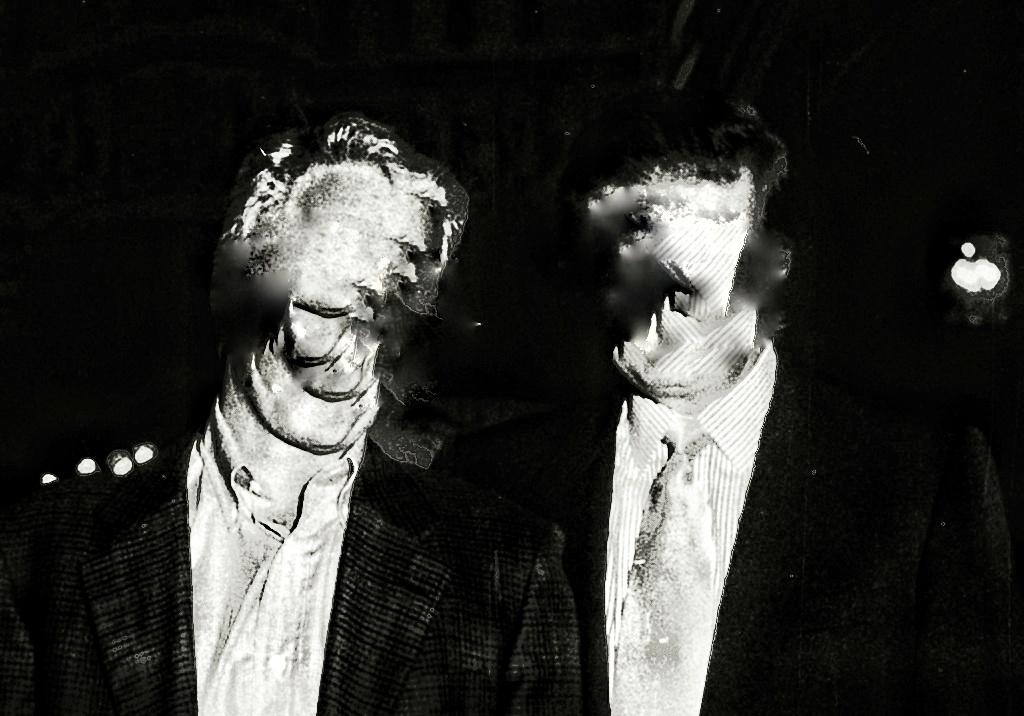
Everyone is aware that life is parodic and that it lacks an interpretation. Thus lead is the parody of gold. Air is the parody of water. The brain is the parody of the equator. Coitus is the parody of crime.
Georges Bataille. L’anus Solaire (1927).
For the bourgeoisie, capital’s human mask, endowed with flesh, voice, taste, and habit, the world is but an asset portfolio. It does not just simply possess assets, but experiences the world itself as an asset-form. Mountains appear as ore, rivers as conduits, cities as speculative surfaces. Some assets are mineral, some are financial, some are human. For this species, human nature is not more than the will to possess, and possession is proven most exactingly by destruction.
There are crimes that announce themselves with the unapologetic vulgarity of force. The shattering of a glass window at a descending rock’s contact; the warmth and brightness of spilled blood; a bullet whizzing past from a crackling muzzle; fracturing bones bent in unlikely directions; the blaring tinnitus-inducing siren of riot police. And there are crimes that pass without sound, whose violence dissipates only as a dull pressure in the social atmosphere, a cosmic background radiation of harm that no crime-o’-meter device is quite tuned to pick up, let alone measure. Mature bourgeois power prefers crimes that feel like weather—ambient, omnipresent, deniable. Ultimately, banal. Sometimes these two are not even so mutually exclusive, and prove to be complementary as if meant to accompany each other. (Sometimes indiscriminate, genocidal air-bombing and drone-striking in the Middle East counts as weather.) Crimes that diffuse responsibility so completely that they cannot be localized in a subject, only in a system that officially does not exist. The latter are the crimes that do not count. They are not invisible, but in fact appear endlessly, refracted through scandal, journalism, hearings, and leaks, and yet they fail to crystallize into judgment. More, say, overexposed, than anything. The recent exposure of the Epstein files belongs squarely to this second category.
Despite the outrage, and not a shortage of it, expressed by liberal imaginations, regretfully finding audience in our ringing ears, petty-bourgeois on-lookers, and that fraction of the American bourgeoisie which is now ready to dispose of the person of Jeffrey Epstein, it would be a mistake to treat Epstein as an aberration, a pathological individual whose excesses embarrass an otherwise functional order. That narrative is itself one of those uncountable crimes. The figure of the monster is useful precisely because it isolates guilt, drives it away from the creator of that monster. Bourgeois society requires such figures as Trump, Epstein, Netanyahu in order to preserve its self-image. Evil must be personal, exceptional, deviant, because this way it is easier to dispose of the spreading cavity and maintain a pearly-white veneered smile. What cannot be admitted is that the conditions which made these people possible are not accidental but profoundly central to the operations of capital.
What occurs there, in the meticulously maintained compound, is the enactment of not merely the exchange of things, but the final, perfect reduction of all that is human to the status of a consumable thing—of absolute commodification. Here, the bourgeois dream finds its terminus: total liberation of appetite from consequence, the transformation of every boundary, of age, of consent, of dignity, into a negotiable line item. This bourgeois ontology of decadence is a worldview that has consumed itself and now, hungry still, consumes the very possibility of innocence. The young bodies trafficked across those waters were not just victims of a man but sacrifices on the altar of a specific idea of power. A power that believes itself to be outside law because it itself is the source of law. A power for which other people are merely landscapes to be traversed, resources to be extracted, toys to be owned, abused and torn, limb to limb.
Secular rituals
One does not need to resort to conspiracy to grasp this. The capitalist class, as a historical formation, has always distinguished between legality and legitimacy in a way that flatters its own reproduction. The law is sacred insofar as it secures property, contract, inheritance, and command over labor. Outside this narrow circuit, morality becomes flexible and discretionary, even aesthetic in its own right. Bourgeois ethics is zoned, where certain spaces are marked off as exceptional, insulated from consequence, and acts that would be criminal elsewhere become trivial, misunderstood, or regrettable but forgivable, and this is why borders are not simply arbitrary lines drawn on paper but licenses to kill on-sight, the creation of a non-person in real-time. Such zones are often boardrooms, presidential houses, diplomatic salons, Switzerland, private jets, and gated communities. Epstein’s island was one of them. The apparent contrast between the anti-immigrant ICE raids and Epstein’s island as zones of exclusion, logically consistent as they are in function, is merely a matter of scale. Having achieved a terrifying degree of negative freedom from all constraint, the bourgeois now experiences the very thereness of the unconsenting Other as an ontological irritant, an existential bane to his survival. The island and the raid are the twin solutions, dissolving the Other into an experience for the Self—either to take in or to pick apart. An assertion of bourgeois sovereignty so total and therefore so violent it claims for itself the right to define the boundaries of human life.
The scandal of the files, the dramatic revelation of names, is but a misdirecting spectacle of hypocrisy for the sensationalist bourgeois media. To say that they were being hypocritical implies that there exists a rift between professed creed and hidden action. But what creed is being professed? The royalties and presidents, billionaires and savants, whose names flutter through those documents do not, in their heartless of hearts, believe in the morality they preach to the masses. What the Epstein scandal reveals instead is not merely the bourgeoisie’s proclivity to sexual violence, but a general economy of exemption. The bourgeoisie lives by exemption. Its power consists, as an accessory to capital accumulation, of the ability to suspend rules selectively, to create pockets of immunity where consequences cannot penetrate and prying eyes are plucked out of their skulls. This is partly why outrage is always permitted. Outrage costs the presidents, billionaires, technocrats, monopolists, compradores, bootlickers, middle-men, and Wall Street financiers nothing. It even performs a function by allowing society to rehearse its moral vocabulary and relieve its tensions without altering anything fundamental or important enough. One can condemn Epstein endlessly and leave intact the social relations that produced him. Likewise, one can denounce depravity while continuing to venerate wealth, prestige, and access. The denunciation is simply a ritual cleansing.
By now we must already be too familiar indeed with their ideology being one of acquisition, a universe of networks and leverage, the ethics of the deal. The girl, the child, becomes simply a token of ultimate trust within the fraternity, a proof of exclusive membership that says: We are alike, you and I; I, too, am unbound; I, too, operate on the far side of the human.
Oozing from the flight logs and depositions is the putrid guttural stench of a sickness far more pathetic and corrosive that one feels the urge to rip out one’s throat and intestines and give it a deep sterilizing treatment. This, we are confronted, is the boredom of a god that has made the world in its image and therefore has made itself God. Appetite jaded by every legitimate feast, turning finally towards the forbidden not out of Adam’s passion, but out of a desperate, empty curiosity one encounters at the fringes of civilization. Can this too be consumed? Can this final taboo be rendered null? Of course it can for I have willed it so, declares the bourgeois. It is the will to power reduced to the will to degrade, because, in the old tales of the dialectic, the degradation of the other is the last sensation that confirms one’s own untouchable elevation. The orgy is, more than anything, administrative. A culture of the endpoint where every frontier of experience has been mapped and commodified, the decadence of a class that has won so completely it has nothing left to conquer but the ruins of its own youth’s proclaimed morality. What of capitalist society that produces such an island and such monstrous people? It looks away. Does it have a choice? No, it simply must.
Tao po1, anyone home?
Bourgeois society is haunted by its own emptiness. It accumulates without purpose, consumes without satisfaction, moralizes without conviction. The bourgeois moral subject is not one who asks what ought to be done, but one who asks what can be gotten away with. To live under capital is to breathe air faintly scented with decay at all times, the way one acclimates to a nearby landfill until the stench only returns when the wind shifts.
The operations of class power require a certain obscurity. The island works because it is an open secret and therefore officially non-existent. Its power is the power of the unspoken. The pilots knew; the secretaries knew; the assistants who scheduled the flights knew; the locals, seeing the young girls and the old men—they all knew. But it did not count. The genius of bourgeois crime is in creating categories of transgression that the system is engineered not to see, or to see only as personal failing, individual pathology. A man steals a loaf of bread, and the full weight of the law descends upon his entire being! But the crime, their Crime, vanishes into the realm of conspiracies and silenced accusers—dead or disappeared, the details hardly matter. It becomes atmospheric, a rumor, a dark folktale, until it is forced into the light. And even in the light, it is fractured into a thousand individual tragedies, severed from the structural reality that made it not only possible, but inevitable.
Epstein’s island is not a cesspool beside the White House—in fact an integral part of its architecture, it is the palace’s septic tank. (It is not even really a physical location in space, more like a paradigm, ever present, the after-party behind every front room; there is more than zero and therefore more than just one.) The elegant soirees in Manhattan penthouses, philanthropic galas, panels at Davos where the fate of the world is discussed, these are the front room; the island is the back room. Being the Id to the super-Ego, both are necessary for the functioning of the whole. The philanthropy launders, foremost, reputation, while the various intellectual conferences of the bourgeoisie, vacuous as they are meant to be, brush the shiny gloss of ideology, a purpose, a hundred coats over. Completely translucent and as such perfectly opaque. The island (or rather what it represents) provides the dark, sustaining fuel of absolute domination, the proof among peers that they have transcended the common lot.
Accretions
Capital accumulates like a corpse bloating in heat, swollen with gases it cannot release, poisonous to the touch. Its institutions creak and ooze, preserved by ritual and repetition, long depleted of vitality. The grotesque emerges as a densely polluted atmosphere, with laughter that rings hollow, generosity reeking of decay, celebrations atop mass graves. But it lingers. The crimes dissipate into thin air but never quite disappear; the simples which constituted them now constitute the earth’s atmosphere. They sediment in accretions as a vague sense of wrongness, a background disgust that no gag-inducing concoction of reform can quite dispel. Workers may not draw revolutionary conclusions immediately, this is true, but they feel the stench. Something is irredeemable. More than enlightening, these scandals become corrosive, eating away at whatever residual belief remains in the moral legitimacy of the bourgeoisie. And for the proletariat, this matters, but not quite in the way liberal commentators imagine. The task is not to demand cleaner elites or more ethical philanthropic billionaires but to instill in the class a lucidity that the morality of the ruling class is structurally incapable of accounting for the harm it produces.
What, then, does it mean to take such crimes seriously? Plainly, it is to refuse their isolation. To insist that they are continuous with wage labor, with imperial plunder, with misogyny and rape culture, with racism and the legacy of colonialism, with the quiet attrition of everyday life under the despotism of capital.
The bourgeoisie will not be shamed out of existence; its many heads must roll. Until then, their crimes against the working class, humanity, and the planet will continue not to count. They will pile up, leak out, horrify briefly, then sink back into the archival pile of excrement of pre-history. Bourgeois society will continue to survive its own exposure because endurance might as well mean legitimacy. And those who feel the weight of this putridity, who cannot look away without nausea, will face a choice: to adapt to barbarism, or to align themselves with its abolition.
For now, the island exists, then disappears. Names circulate, then dissolve. (Nothing follows.)
Notes
- Filipinos say “Tao po” (literally: “a person here”) when knocking on a house. Originating in folklore, it is said that Filipinos do this so people inside know it is a human being knocking outside, and not something else, implying that other non-human entities such as aswang (lit. ghouls) and engkanto (lit. spirits), while able to shape-shift into human form, are incapable of verbalizing their humanity since they have none. ↩︎